
Your anxiety didn’t arrive from nowhere. You’ve been treating it like weather. Like something that rolls in without a source and parks itself in your chest until the sitting ends on its own schedule.
But anxiety has a supply chain. A series of daily habits deliver raw materials to a factory in your chest. That factory processes the raw materials into tightness, racing thoughts, and 2 AM ceiling-staring. It has been running so consistently that the output feels like a permanent feature of your operating system. It isn’t. The anxiety is the output of inputs you provide every day without realizing it.
This article is the audit. Ten deliveries arrive at your factory daily. Each one carries raw materials that get converted into the thing you’ve been trying to manage with breathing exercises and apps. Those tools help. But they treat the output while the input continues. And the continuing is why the factory never shuts down.
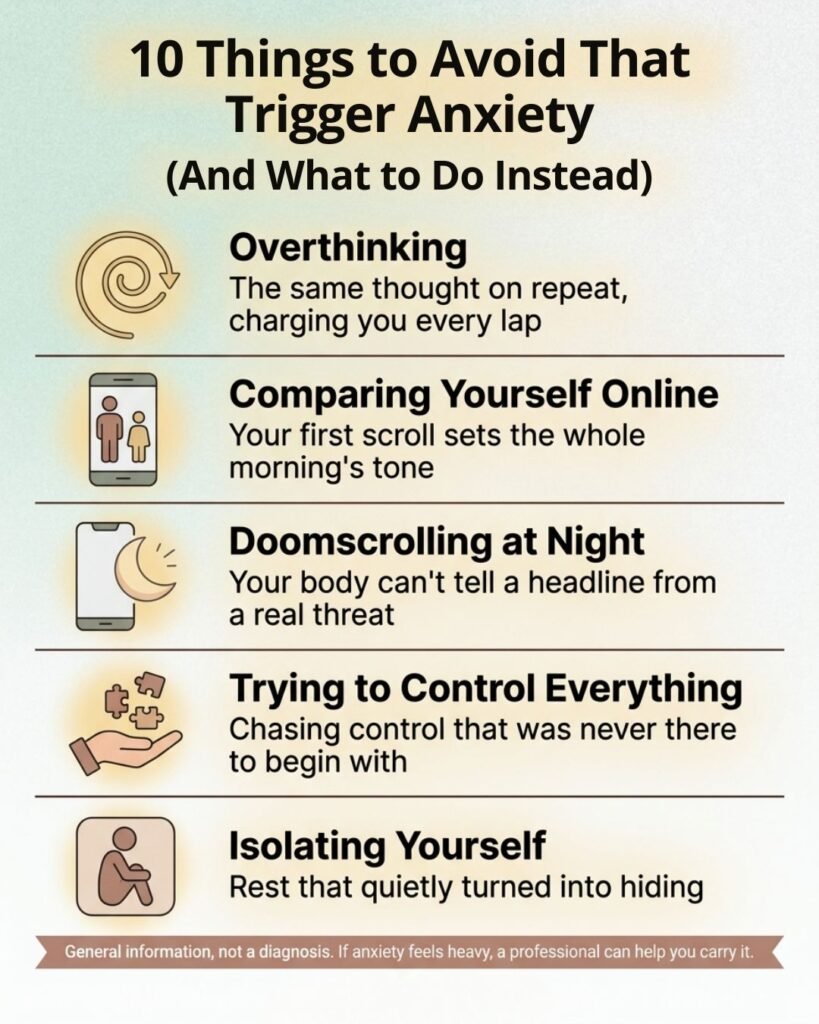
Cut the inputs. Give the factory nothing to process. That silence in the chest you’ve been chasing ends when the deliveries stop.
Here are the ten deliveries.
1. Overthinking: The Loop That Charges Admission Every Lap
A thought arrived once. You processed it once. Then it arrived again. Same thought, same processing, same conclusion as before. That identical conclusion should have ended the loop. But loops don’t respond to conclusions. They respond to uncertainty. Uncertainty is infinite, which produces infinite laps, and each lap charges admission in the form of energy your day needs elsewhere.
Overthinking isn’t thinking. Thinking produces new conclusions from new data. Overthinking produces the same conclusion from the same data on repeat. If you’ve processed the thought before and reached a conclusion that hasn’t changed, you’re not thinking. You’re looping. And looping is the first delivery truck on the supply chain.
What to do instead: Set a timer for ten minutes. Think about the thing deliberately. When the timer ends, the thinking is done for today. What you’re overthinking will still be there tomorrow. It hasn’t changed in the last forty-seven laps and won’t change in the forty-eighth.
2. Comparing Yourself to Others: The 8 AM Ambush
A comparison happened before your coffee was ready. Your first scroll of the day produced someone who is further along. That triggered a calculation saying you’re behind, which produced urgency, which produced anxiety before 8:15 AM. One scroll set the chemical tone for the entire morning. And that tone was threat.
You’re cross-referencing your behind-the-scenes with someone else’s highlight reel. That comparison produces a number that means nothing because it excludes the variables that make two lives incomparable. You share a species with this person. You don’t share a starting point, a timeline, circumstances, or a definition of success.
What to do instead: Delay your first scroll by thirty minutes. Let the morning’s first input be coffee, a shower, or quiet. A different first input produces a different chemical tone, and that tone carries the morning further before anxiety has raw material to work with.
3. Saying Yes When You Mean No: The People-Pleasing Pipeline
Your yes was automatic. It fired before any boundary could intervene. A no would have cost you the discomfort of someone’s reaction. You avoided that discomfort by saying yes. But avoiding one discomfort produced a different one: the overwhelm of a calendar full of obligations installed by other people’s requests.
Every yes that should have been a no is a commitment your body has to fund. That funding comes from the same energy budget reserved for your own priorities. Your priorities keep getting pushed to the bottom of a list that refills from the top faster than you can reach the bottom.
What to do instead: Before saying yes, pause for five seconds. Ask one question: “Am I saying yes because I want to, or because I’m afraid of what happens if I say no?” If the answer is the second one, that yes is a delivery truck. Reroute it with a no. That no is a boundary, and boundaries reduce the supply.
4. Doomscrolling at Night: The 11:47 PM Delivery
You’re lying in bed. Your body is ready for sleep, but your brain is not. It’s processing content served by an algorithm refined by billions of data points to maximize engagement. What was supposed to last “just two minutes” became forty-five. Those forty-five minutes produced a chemical deployment your body now has to metabolize before sleep can begin.
Your nervous system can’t tell the difference between a threat on your screen and a threat in your bedroom. A headline produced a cortisol release identical to what your body would produce if the headline’s content was happening in your living room. Your body doesn’t read location tags. It reads threat levels. And the level was high. Now that cortisol is circulating in a body that needs to sleep but can’t because the metabolizing hasn’t finished.
What to do instead: Charge your phone outside the bedroom. Removing the delivery vehicle from the room eliminates the 11:47 PM delivery entirely. It feels extreme for about three nights. After that, it feels like the best decision you’ve made this year.
5. Skipping Sleep: The Debt That Compounds
Sleep debt started small. One late night. Then a second, produced by the first night’s residual alertness. Then a third, where your body tried to sleep and failed because two nights had shifted your internal clock. A new baseline formed. That baseline runs later than the old one, and the deficit compounds nightly.
Sleep is your body’s maintenance window. During that window, chemicals from the day get cleared. That clearing is the reset that produces tomorrow’s capacity. Skip the window, and those chemicals accumulate. They become raw materials for the anxiety factory, and the factory’s output hits harder on days that follow a skipped maintenance window.
What to do instead: Protect the last hour before bed the way you protect your first meeting of the morning. That hour belongs to winding down. Build your sleep on-ramp from boring materials: a warm drink, dim lights, and reading something that doesn’t spike cortisol.
6. Avoiding Difficult Conversations: The Internal Loop Generator
A conversation you’re avoiding is not dormant. It moved from the external to the internal the moment avoiding began. Inside your head, it’s louder than the real version would have been. Why? Because the internal version runs on a loop that never ends. Real conversations have beginnings, middles, and endings. Your internal version has a beginning and no end. That missing end is consuming the bandwidth the real ending would have freed.
You’ve rehearsed this conversation forty-seven times. Each rehearsal consumed energy and delivered raw materials to the factory. Three weeks of rehearsal anxiety now exceeds what twenty minutes of real conversation anxiety would have produced. By every metric, avoidance is a net loss.
What to do instead: Say the first sentence. Not the perfect one. Whatever version is available right now. Version twelve is fine. Real conversations go differently than any of the forty-seven rehearsed versions because real people don’t follow scripts your head writes for them.
7. Trying to Control Everything: The Infinite Gap
Controlling feels productive. It feels like the responsible approach of someone who cares about outcomes. But controlling means constantly monitoring variables that can’t be monitored. That inability creates a permanent gap between desire and ability. Total control doesn’t exist. And chasing something that doesn’t exist is what feeds the factory. So the factory produces the exact anxiety that controlling was supposed to prevent.
Here’s the structural irony. What you’re doing to prevent anxiety is what’s producing it. Control more, and anxiety increases because controlling reveals more uncontrollable variables. More variables mean more gaps, which mean more anxiety, which means more controlling. It’s a loop that feeds itself.
What to do instead: Identify one variable you actually control. Your effort, your response, or your preparation. Focus your controlling energy there. Release the variables that belong to other people, other timelines, and other outcomes your controlling can’t influence regardless of how much energy it consumes.
8. Ignoring What Your Body Is Telling You
Your body sent a memo last week. A headache on Tuesday that arrived without a trigger. Then a clenched jaw during a meeting that wasn’t stressful enough to produce clenching. And a stomach that tightened during a conversation your conscious mind filed under “fine” while your body filed under “threat.” Three memos, same sender, same message, all ignored.
Bodies communicate through physical symptoms because they don’t have words. They use tension, tightness, and that specific shoulder ache at 3 PM. That ache is a memo saying “what you told me was fine wasn’t fine, and I stored the not-fine in the shoulders because that’s where I put things you won’t acknowledge.”
What to do instead: Check in with your body once during the day. A thirty-second scan. Start at the jaw and move down through shoulders, chest, and stomach. That scan reveals memos your conscious mind has been ignoring. Revealing them is the first step in the processing your body has been requesting.
9. People-Pleasing: Stretching Until You Snap
Stretching started early. It got installed during a period when your value was measured by your usefulness to other people. That measuring produced a policy: the useful version gets love, the not-useful version gets distance. You avoided the distance by stretching. And stretching became your primary relationship strategy.
Now you stretch in multiple directions at once. One direction for the friend who needs listening. Another for the coworker who needs covering. Another for the family member who needs fixing. Each direction pulls from a finite supply of available material. That supply has a limit, and the limit is approaching. Your anxiety right now is your body warning you that the snapping is close.
What to do instead: Next time someone asks for a stretch, ask yourself whether it will cost you a piece you can’t afford to lose today. If the answer is yes, decline. That declining is a boundary, and that boundary is what keeps the snapping from happening.
10. Isolating Yourself: The Box That Feels Like Protection
Isolating started as rest. Needed rest. Appropriate rest. It lasted three days, and those three days brought real healing. Then three days became a week. A week became a habit. And the habit became a box built from rest that overstayed its welcome. What started as healing became hiding, and hiding is a delivery.
A box feels like protection. It feels like responsible management for someone too tired or overwhelmed to participate in the outside world. And it IS protection, for about seventy-two hours. After that, the box becomes a container that produces a different kind of anxiety than the outside world produces.
Outside-world anxiety comes from too much stimulation. Isolation anxiety comes from absence. Absence of connection. Absence of mirrors that reflect the version of you that others see. Those mirrors keep your internal narrative honest. Without them, your narrative drifts toward the dark when left unchecked too long. That drifting is the delivery.
What to do instead: Send one text. To one person. Today. Not a paragraph, just a sentence. “Hey, thinking of you.” That sentence cracks the box. Light gets in through the crack. And light interrupts the drifting that turns rest into hiding.
The Audit Starts Tonight
You’re not going to reroute all ten delivery trucks today. That’s the intensity approach, and intensity cracks the jar. Cracking sets the timeline back further than it advances.
Reroute one. Tonight. Pick the one you recognized most while reading this. Whichever trigger produced the tightness in your chest, that tightness was recognition. Your body was saying, “That one. That’s the delivery I’ve been trying to tell you about.”
Start there. Reroute that delivery. Let the factory sit idle for one input cycle. That idling begins the quiet your chest has been requesting since the supply chain started running.
A factory doesn’t shut down in a day. It shuts down when deliveries stop. And deliveries stop one truck at a time, starting with the one you choose tonight.
Frequently Asked Questions
What are the most common daily triggers for anxiety?
Common daily triggers include overthinking, comparing yourself to others on social media, saying yes when you mean no, scrolling your phone before bed, skipping sleep, avoiding difficult conversations, trying to control outcomes, ignoring your body’s signals, people-pleasing, and isolating yourself. Each one delivers raw materials to the anxiety response in your body. Most operate so quietly you don’t recognize them as triggers until you deliberately audit your daily habits.
How do I stop overthinking and reduce anxiety?
Overthinking produces the same conclusion from the same data on repeat. If your conclusion hasn’t changed, thinking has become looping. Set a ten-minute timer, think about the thing deliberately, and when the timer ends, the processing is done for today. What you’re overthinking will still be there tomorrow and hasn’t changed in the last forty-seven loops.
Why does scrolling my phone at night make anxiety worse?
Your nervous system can’t tell the difference between a threat on your screen and a threat in your bedroom. Every alarming headline produces a cortisol release identical to what your body would produce if the threat were real and present. That cortisol needs to metabolize before sleep can begin, which is why sleep after scrolling is shallow and the next morning starts with a deficit anxiety uses as fuel.
Can people-pleasing cause anxiety?
Every yes that should have been a no is a commitment your body funds from the same energy budget it uses for your own priorities. That funding depletes your reserves, which produces overwhelm, which produces anxiety. Try pausing five seconds before saying yes and asking whether the yes comes from desire or from fear of what happens if you say no.
How long does it take to reduce anxiety by changing daily habits?
An anxiety supply chain doesn’t shut down in a day. It shuts down when deliveries stop, and deliveries stop one habit at a time. Most people notice a measurable difference within two to three weeks of consistently rerouting even one or two delivery trucks. Consistency matters more than quantity because the factory runs on regular deliveries, and stopping even one makes a bigger impact than a one-time attempt to stop all ten.