
You walk into the kitchen and stop. Why did you come in here? The kettle is off, the fridge is closed, and your mind is blank. You laugh it off. Still, a small voice wonders if this is how things will go from now on.
A science journalist named Melissa Hogenboom had her own version of that worry. In 2023 she lay inside a brain scanner at Royal Holloway, University of London, and then spent six weeks trying to change what the machine would see. She wrote about it for BBC Future. She wanted to know if ordinary daily habits can rewire your brain as a grown adult. Then she went back for a second scan.
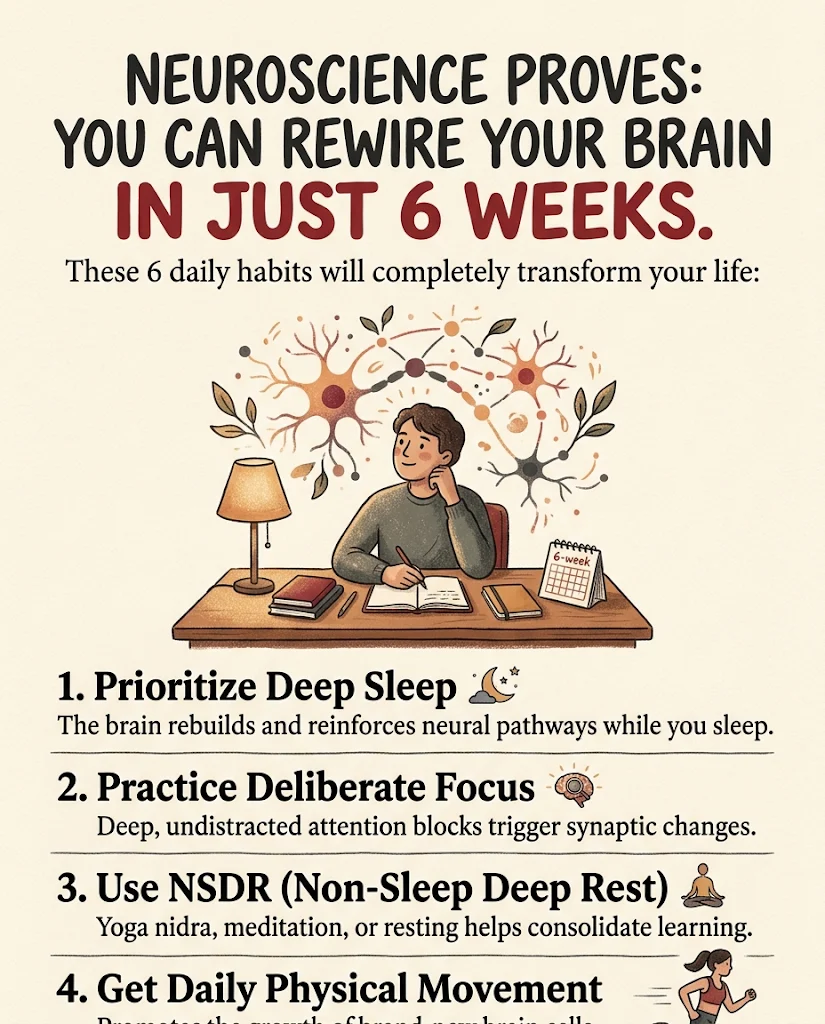
What Happened In Those Six Weeks
Her plan was quiet, almost boring. Every day she listened to a guided mindfulness recording for half an hour, sometimes in one sitting and sometimes split in two. Her only job was to notice where her thoughts went. Most days, she admits, they drifted off to old chats with friends and a dentist appointment she still had to book.
The course came from Thorsten Barnhofer, a professor of clinical psychology. He explained that when stress hormones stay high for a long time, the brain becomes less able to change. So calming the mind came first.
After six weeks, Barnhofer stayed up late comparing her two scans. One side of her amygdala, a small almond-shaped area tied to fear and strong feelings, had shrunk a little. Hogenboom stayed honest about it. One person is not a study, she pointed out, and her test was meant to show an idea rather than prove it.
Even so, her result fits with bigger research. When scientists at Massachusetts General Hospital followed 16 people through an eight-week mindfulness course, they saw denser gray matter in the hippocampus, the area that helps you learn and remember, as Greater Good reported. In that same group, people whose stress dropped the most also showed changes in the amygdala, according to Harvard Health.
Can You Really Rewire Your Brain After 40?
For years, many people believed the adult brain was more or less finished. Doctors now know it keeps changing for life. Every time you practice something, the cells involved talk to each other a bit more easily. Stop for months, and those links grow weaker. Scientists call this neuroplasticity.
The brain does get a little less flexible with age, so change takes more effort than it did at 20. But effort is the part you control. So yes, you can rewire your brain at any age. Six weeks won’t turn you into a new person. Still, it is long enough for a habit to start feeling normal, and a habit you keep is what does the work over the years.
Habits also take longer to stick than the old 21-day rule suggests. In a UCL study led by health psychologist Phillippa Lally, people needed 66 days on average before a new daily action felt automatic. Some got there in 18 days, while others needed far longer. Missing one day made no real difference. So if week three feels like a chore, you are right on schedule.

Habit 1: Give Your Mind A Quiet Half Hour
This is what Hogenboom did, and it costs nothing. Sit in a chair after breakfast, close your eyes and follow your breathing. When your mind runs off to the grocery list, notice it and come back. That noticing is the exercise.
You don’t need special music or a cushion on the floor. Free guided recordings work fine. If thirty minutes feels endless, start with ten and add a few minutes each week. Many women find it easiest right after the morning coffee, before the phone starts buzzing.
Habit 2: Walk Briskly A Few Times A Week
In a study published in PNAS, researchers split 120 inactive older adults into two groups. One group worked up to walking around a track for 40 minutes, three days a week. The other did stretching and toning. After a year, the walkers’ hippocampus had grown by about 2 percent, while the stretching group lost a little over 1 percent. Most of the walkers were women in their 60s.
Kirk Erickson, the lead author, said scientists had long seen that shrinking as nearly unavoidable later in life. Yet a moderate walking routine turned the clock back by roughly one to two years. That means an evening walk with a friend after dinner counts. If you want an easy way in, our piece on Japanese walking explains a simple pattern of three fast minutes and three easy ones. Check with your doctor first if you have heart trouble, sore joints or any condition that limits exercise.
Habit 3: Learn Something That Feels Hard
Crossword puzzles you already finish in ten minutes won’t do much. Instead, the brain responds to new and demanding work. Psychologist Denise Park at the University of Texas at Dallas tested this with 221 adults aged 60 to 90 in what she called the Synapse Project. For three months, some learned digital photography and photo editing, and some learned to design quilts. Others joined a social club or did easy activities at home.
Only the groups learning hard new skills improved their memory, and photography helped most. One volunteer, 82-year-old Jimmy Wilson, learned to use a computer, a camera and Photoshop for the trial, as NPR described. Park’s advice was blunt. When you stay where things feel easy, your brain has little reason to improve.
So pick something that makes you a little clumsy at first. Watercolors, a language app, piano lessons at the community center or editing videos of the grandkids all qualify.
Habit 4: Protect Your Deep Sleep
Your brain does much of its sorting at night. During deep sleep it stores what you learned that day and clears space for tomorrow. Sleep researcher Matthew Walker told NIH News in Health that sleep after learning helps save new information for the long term.
Here is the catch for women over 40. Deep sleep starts to fade in our late 30s. In Walker’s research, adults over 60 had about 70 percent less of it than people aged 18 to 25, and they remembered less the next day. Keep the bedroom cool and dark, go to bed around the same time, and leave the tablet in the kitchen. If you wake every night at 3 a.m. or snore loudly, mention it to your doctor. Some readers also ask about magnesium before bed, and that is a good question for the same appointment.
Habit 5: Keep People Close
Feeling alone takes a toll beyond your mood. In a Johns Hopkins study of 5,022 Americans aged 65 and older, about one in four were socially isolated. Over nine years, those isolated adults had a 28 percent higher chance of developing dementia than the rest.
A real conversation makes the brain work hard. You follow a story, recall names, read faces and come up with an answer on the spot. So call your sister instead of texting. Join the Tuesday walking group. Invite a neighbor over for tea. Even a weekly card game with friends gives your brain a workout and something to look forward to.
Habit 6: Lower The Pressure, Then Repeat
Remember why Hogenboom started with mindfulness. Long-term stress makes the brain less able to adapt, so anything that keeps you calm helps every other habit work better. If you have felt drained for months, our article on emotional exhaustion has gentle steps that may help.
After that, repeat. Brain connections get stronger each time you use them and fade when you stop. Tie each new habit to something you already do. Walk after you drop off the grandkids. Sit quietly after your first cup of coffee. Practice your new skill while dinner simmers on the stove.
In this short TEDx talk, brain researcher Lara Boyd of the University of British Columbia explains why practice changes each person’s brain in a slightly different way.
Final Thoughts
You can rewire your brain at 45, at 60 or at 80. It won’t happen over a weekend, and nobody needs a scanner to prove it worked. Six weeks of quiet minutes, brisk walks, new skills, good sleep and real conversations is a fair start. Keep going after that, and those blank moments in the kitchen may start to feel a lot less scary.
Which of these six habits do you already have, and which one will you try first? Let us know in the comment box below.