
It’s the second week of December when your daughter calls. She sounds a little nervous. “Mom, we’re going to Mark’s parents this year. It’s their turn, and the flights are crazy anyway. You understand, right?”
“Of course, honey,” you say. “Don’t worry about me.”
Then you hang up and look at the little tree you already put up in the corner, the one with the ornaments the kids made in kindergarten, and you realize that for the first time in your life, you’ll probably spend Christmas Day alone in a house that used to be so loud on December 25 that you could barely hear the oven timer.
If that’s where you are this year, you’re in much bigger company than you might think. In this article we’ll look at why so many people spend Christmas alone after 60, what research says about the difference between being alone and being lonely, and how to plan a Christmas alone that actually feels good. So, let’s go through it.
You’re Not the Only One
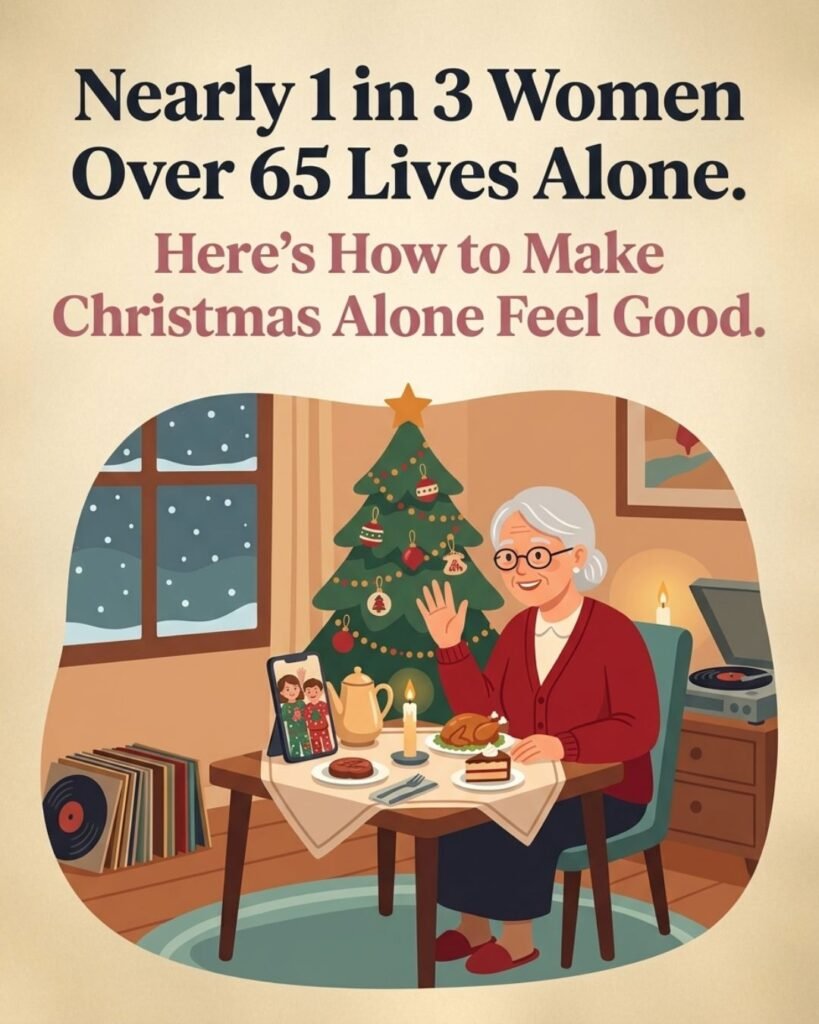
According to Pew Research Center, about 26% of Americans 65 and older lived alone in 2023. For women, it’s 31%, and among people 85 and older, it rises to 38%.
The reasons are ordinary ones. Women tend to outlive their husbands. More couples divorce later in life. Grown children move across the country for work, or they alternate holidays with their in-laws, so every other year the house is quiet. Friends move closer to their own grandchildren.
And many younger couples are simply changing how they do the holidays, which I wrote about in why more couples now skip Christmas with their parents. None of this means anyone stopped loving you. Families just look different than they did when we were growing up.
Loneliness is also on the rise. In a 2025 survey of more than 3,200 adults 45 and older, AARP found that 40% felt lonely, up from 35% in 2010 and 2018. Interestingly, the report found that loneliness tends to fall with age, and the highest rates were among the youngest people in that group, not the oldest.
Alone Isn’t the Same as Lonely
This is the most important idea in this whole article, so I’ll take a moment with it.
In 2023, psychologist Netta Weinstein and her colleagues asked 178 adults aged 35 and older to keep a daily diary for up to three weeks, tracking how much time they spent alone and how they felt. According to the University of Reading, days with more time alone were linked to less stress and a stronger feeling of being free to be yourself. But those same days also came with more loneliness and lower life satisfaction.
Here’s the part that matters for Christmas. The negative effects were much smaller, or disappeared entirely, when people chose to be alone rather than having it forced on them.
So the same quiet day can feel peaceful or painful, depending on whether it feels like your choice. You can’t always choose your circumstances. But you can often choose how you spend the day, and that seems to make a real difference.
That’s why the rest of this article is really about choices. Small ones, mostly.
Decide What Kind of Day You Want
Before December 24, sit down with a cup of coffee and ask yourself honestly: what would make this day good for me? Not what’s expected, not what you did for forty years, but what you actually want this year.
If You’d Like Company
There are more options than people think. Many churches and senior centers host Christmas Day meals, and some need volunteers to serve them.
Volunteering is worth a serious look. In a 2020 study of nearly 13,000 adults over 50, researchers at Harvard found that people who volunteered about two hours a week had a lower risk of dying and better well-being over the following four years, along with a stronger sense of purpose. Serving Christmas dinner at a shelter or delivering meals with a local program might be one of the warmest ways to spend the day.
You can also host. Think about who else might be alone, like the widowed neighbor down the street or the friend from church whose kids live overseas. A simple “Would you like to come over for Christmas lunch? Nothing fancy” can change two people’s holidays at once.
Psychologist Susan Pinker explains in her TED talk why regular, face-to-face contact may be one of the strongest predictors of a long life. She studied the long-lived villages of Sardinia, and her findings might make you pick up the phone.
If You’d Like a Quiet Day
That’s a perfectly good choice too. The trick is to treat it like a real holiday instead of an empty Thursday.
Plan the menu, even if it’s for one. Buy the good chocolate. Pick out the movie you’ve wanted to see for years, or the book you’ve been saving. Put on something nicer than your sweatpants. It sounds silly, but getting dressed tells your brain that today is special.
Picture it. Late morning, a long phone call with your grandchildren while they open presents. A walk in the cold air. Then a small roast, a glass of wine, an old Christmas movie and nobody asking you to do the dishes. Many women who’ve tried it admit, a bit guiltily, that it was one of the most relaxing Christmases they’ve had in decades.
Cooking for One
I’ll admit it, I think roasting a whole turkey for one person is a terrible idea. You’ll be eating turkey sandwiches until Valentine’s Day.
Instead, pick one thing you really love from the traditional meal and make a small version of it. A couple of chicken thighs or a small piece of salmon, and one slice of a really good cake from the bakery. If you do cook more, freeze the leftovers in single portions, and you’ll have easy dinners in January when the days are short and nobody feels like cooking.
Set the table properly, too. A cloth napkin and a candle cost almost nothing, and they turn dinner into an occasion.
If You’d Like Something Completely Different
Some people use the time to travel. Tour companies and cruises often run holiday trips that suit solo travelers, and you’ll find plenty of people your age there doing exactly the same thing. Others skip Christmas altogether and spend the day on a project they love, like painting or finally sorting the old photo albums.
There’s no rule that says Christmas has to look the way it always did.
One of the nicest things about this stage of life is that nobody can tell you how to spend your day anymore. You’ve cooked for forty Christmases. If you want toast and a long bath this year, you’ve earned it.
Plan It Before It Arrives
Waiting to see how you feel on the day is usually a mistake. By then, most shops have closed and friends have made their own plans. The quiet can feel much heavier than it would have with a little preparation.
So make your plan in early December. Put the phone calls in your calendar and book the volunteer shift, if that’s what you’ve chosen. If your family is celebrating without you, ask them to video call at a specific time, so you have something to look forward to rather than waiting by the phone all day.
Just a tip. Plan something for December 26 as well. For many people, the day after is actually harder than Christmas itself.
Small Things That Make the Day Feel Good
Get outside, even for twenty minutes. Daylight and movement both help your mood, and a brisk walk on Christmas morning can set the tone for the whole day. If you’d like to make it a habit, I wrote about how to lose weight by walking.
Keep one tradition that’s yours. Maybe it’s your mother’s cookie recipe or a certain record you always play while decorating. Traditions don’t need an audience.
Reach out to someone else who might be alone. A quick call to an old friend on Christmas morning often helps the caller as much as the person who answers.
Put on music you love, loud if you want. Nobody’s going to complain about hearing the same Bing Crosby album three times in a row, and there’s something about singing along in your own kitchen that makes the house feel full again, even if it’s only for a song or two.
And go easy on the scrolling. Social media on Christmas Day is full of perfect tables and matching pajamas. Those pictures are a highlight reel of somebody’s best ten seconds, and scrolling through them rarely makes anyone feel better.
What to Say to Your Family
Many parents tell their kids “it’s fine” and then spend the day feeling hurt. Try to be honest without making them feel guilty.
Something like, “I’ll miss you this year, but I’ve made some nice plans. Could we have our own Christmas on the 28th?” works much better than silence or a sigh. A “second Christmas” a few days later can be just as warm as the real thing, and often less stressful for everyone.
And if you’d actually like an invitation somewhere, say so. People often assume you’d rather be at home.
On the other hand, if you’re the one choosing a quiet Christmas, tell your children that clearly too. Otherwise they may spend the whole day worrying about you instead of enjoying their own celebration. “I’m genuinely looking forward to a calm day. Call me in the afternoon and tell me everything” can take a big weight off their shoulders.
If It’s Your First Christmas Alone After a Loss
This is a different situation, and it deserves its own space. If your husband died this year, or you lost a close friend or a parent, the first Christmas can be one of the hardest days of the whole first year.
Some people find it helps to change things a little. Sit in a different chair at the table, or have Christmas lunch somewhere new. Others want everything exactly as it always was, down to the same carols on the same old CD. Both are fine.
Many families light a candle for the person who’s missing, or tell one favorite story about them before dinner. It doesn’t make the absence smaller. But it can make it feel shared instead of hidden.
And if you find yourself crying over the gravy, let yourself. Grief has a way of arriving right on schedule at the holidays.
A Word About Holiday Scams
This isn’t a cheerful topic, but it matters. People who live alone are a favorite target of scammers, and the holidays are busy season for them. According to the Federal Trade Commission, adults 60 and older reported losing about $2.4 billion to fraud in 2024, up from roughly $600 million in 2020. Older adults were much more likely than younger ones to report losing money to romance scams and to people pretending to be from the government.
Be especially careful with a new online friend who suddenly needs money for a plane ticket to visit you at Christmas, or a caller who says your grandson is in trouble and needs cash right away. Hang up, and call your family on a number you already know.
When Being Alone Feels Too Heavy
Sometimes the holidays bring up much more than an empty chair. If it’s your first Christmas after losing your husband or a close friend, it can feel overwhelming, and that’s completely normal.
If you need someone to talk to, the Institute on Aging runs the Friendship Line, a free, confidential phone line for adults 60 and older, open 24 hours a day. The number is 888-670-1360. You don’t need to be in crisis to call. Many people simply call to talk.
Be careful with alcohol, too. A glass of wine with dinner is fine for most people, but drinking alone to get through the day can make low moods worse.
And if you ever have thoughts of not wanting to live, please call or text 988, the Suicide and Crisis Lifeline, any time.
Start Planning for Next Year in January
The best cure for a lonely Christmas often starts eleven months earlier. Join something in the new year, like a walking group or a choir. Take a class at the library or volunteer somewhere once a week.
It takes time to build friendships after 60, and it can feel awkward at first. But by next December, you might have three or four people to call, and maybe a small group that decides to spend Christmas together.
Some of the best holiday traditions start exactly that way, with a few people who were each going to be alone.
One Honest Note
Not everyone who spends Christmas alone is sad about it. Some people feel relief, especially if past holidays were full of tension or difficult relatives. That’s allowed too, and nobody needs to apologize for enjoying a calm day.
Staying connected to people matters for health all year long, and December is a good month to start. If you’re interested in that side, I wrote about the Japanese longevity habits, and community plays a big part in them.
A Different Kind of Christmas
Christmas alone after 60 doesn’t have to be a sad version of the old one. It can simply be a different version, at your own pace, with maybe a few new traditions you’ll want to keep even when the house is full again.