
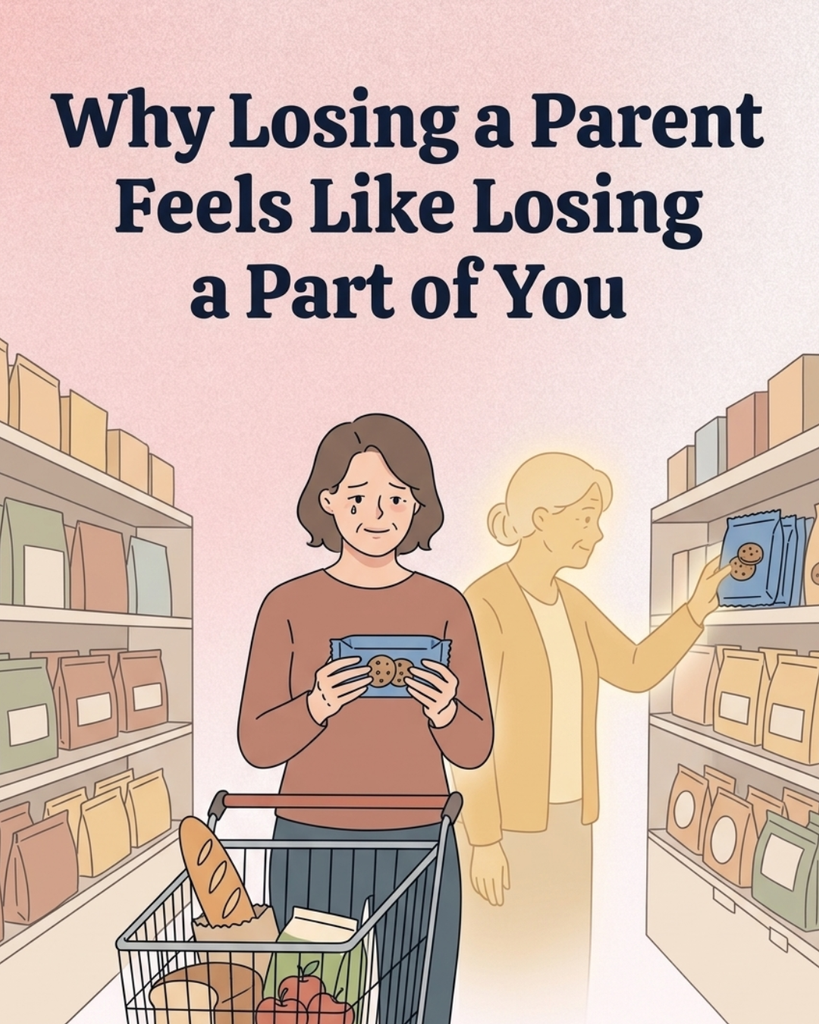
Three weeks after the funeral, you’re standing in the grocery store when you see the cookies your mother always bought, the ones with the blue wrapper that nobody else in the family even liked. You pick up a pack before you realize what you’re doing. Then you stand there in the aisle, holding it, while people push their carts around you and a song she used to hum plays quietly over the speakers, and you have no idea whether to put the cookies back or buy them anyway.
Or maybe it’s the phone. Something good happens at work, and your hand is already reaching for it to call your dad before your mind catches up.
Anyone who has lost a parent knows these moments. Losing a mother or father, even as a grown adult with your own children and gray hair, can feel like losing a piece of yourself. In this article we’ll look at why losing a parent hits so deeply, what it does to your body and your sense of who you are, and how people slowly learn to carry it. So, let’s go through it.
You’re Far From Alone
It sounds obvious, but it helps to hear it. According to the American Psychological Association’s Monitor on Psychology, U.S. Census data show that by age 49, about 44% of Americans have lost at least one parent. By 59, it’s nearly 76%.
So most of the women reading this have either been through it or will be soon. Yet it’s still something we rarely talk about openly. People bring a casserole and send a card. A few weeks later, everyone seems to expect life to go back to normal.
It usually doesn’t. Not that fast. Grief keeps its own calendar, and it rarely matches the one on your kitchen wall.
Why It Feels Like a Part of You Is Gone
There are good reasons this loss cuts so deep, even when you knew it was coming.
They Were There From the Very First Page
Your parents knew you before you knew yourself. They remember the way you said “spaghetti” wrong at three, and the night you came home crying after your first heartbreak. Nobody else carries those memories in quite the same way.
When a parent dies, it can feel like the only other person who held the early chapters of your life has gone. You still have the memories. But there’s nobody left to say, “Remember when you were little and you…”
Your Sense of Who You Are Shifts
Sociologist Debra Umberson of the University of Texas spent years studying adults who lost a parent. She called her book Death of a Parent: Transition to a New Adult Identity. In an interview about her research, she described the experience as a huge upheaval in the way people think about who they are.
The loss of the second parent is often the hardest jolt. As the APA Monitor explains, it can remove the layer that stood between you and your own mortality. Suddenly you’re the oldest generation. There’s nobody above you anymore, and that’s a strange, lonely place to stand at any age.
You Never Stop Being Their Child
You can be 62, a grandmother three times over, and still feel like a little girl who wants her mom when you’re sick. That feeling doesn’t retire. Many people say they miss the person, and they also miss the version of themselves that existed only with that parent. That was the one somebody else looked after.
The Small Habits Disappear
Often it’s not the big moments that hurt most. It’s the Sunday phone call that doesn’t happen anymore, or the birthday card that no longer arrives in his shaky handwriting.
Those small routines held your week together, sometimes for fifty years. When they stop, the silence can be louder than the funeral was.
Some people keep a parent’s number in their phone for years. Some even call it once in a while just to hear the old voicemail greeting. If that’s you, you’re not strange. Lots of people do it.
What Grief Does to Your Body
This is the part people don’t expect. Grief shows up in the body as well as the heart.
Researchers led by Elizabeth Mostofsky studied nearly 2,000 heart attack survivors for a paper in the journal Circulation. They found that the risk of a heart attack was about 21 times higher than normal in the first day after the death of someone close. In the first week, it was almost six times higher. According to the study’s press release, it declined steadily over the following month.
Those numbers sound frightening, so here’s the honest context. They describe relative risk. The actual chance of a heart attack in that first week was still small. It ranged from about 1 in 320 for people already at high risk to about 1 in 1,394 for people at low risk. But it’s real, and it’s a good reason to keep taking your blood pressure or heart medication even when you can barely think straight.
If you feel chest pressure, pain in your arm, jaw or stomach, shortness of breath or a cold sweat, call 911. Don’t assume it’s “just grief.”
Umberson’s research also found that, in the short term, adults’ physical health tends to dip after a parent dies, and that the loss of a father was more often linked to drinking more. Interestingly, over the longer run, many people’s health actually improved, possibly because the loss made them take their own health more seriously.
Just a tip. In the first weeks, set phone reminders for your pills and drink water. Grieving people forget to eat and sleep badly, and both make everything harder.
Grief Comes in Waves
Nobody grieves on a schedule. Some days you feel almost normal, and then a song in a store or the smell of a certain soap knocks you flat. Birthdays and holidays can bring it all back, even years later.
That’s normal. It doesn’t mean you’re going backward.
Grief and Your Marriage
Sometimes a husband doesn’t quite understand. He loved your mother, but she wasn’t his mother. He may expect you to feel better after a few weeks.
Tell him what helps. “I don’t need you to fix it. I just need you to sit with me sometimes.” Most partners want to help and simply don’t know how.
And if your husband is the one who lost a parent, remember that many men grieve more quietly. He might work longer hours or go silent instead of crying. Check in gently.
For a smaller group of people, though, grief stays intense and stops them from living their life. In 2022, the American Psychiatric Association added prolonged grief disorder to its diagnostic manual. For adults, it’s considered when the loss happened at least a year ago and the person still has intense symptoms nearly every day, such as feeling that part of their own identity has died, or a sense that life has no meaning without the person. The APA estimates that about 4% to 15% of bereaved adults experience it.
Notice that first symptom. “Part of me died with them” is such a common feeling that psychiatrists use it as one of the signs. For most people it softens with time. If it hasn’t after a year, therapy really can help, and grief-focused approaches have good results.
Staying Connected Is Healthy
For a long time, people heard that healthy grieving meant “letting go” and “moving on.” Many researchers now see it differently. A well-known idea called continuing bonds, introduced in the 1990s by Dennis Klass, Phyllis Silverman and Steven Nickman, suggests that it’s normal and often healthy to stay connected to the person who died, in a new way, through memories and the small habits you carry forward, rather than trying to close the door on them completely.
That might mean cooking your mother’s soup recipe every winter, even if it never tastes quite the same. Or telling your grandchildren the silly stories your dad used to tell, so they know him a little too.
One therapist quoted in the APA Monitor suggests writing a letter to your parent and then sharing it with someone you trust. Many people find it easier to say things on paper that they never managed to say out loud.
Resilience researcher Lucy Hone talks about getting through grief in her TEDx talk. Her loss was different, she lost her 12-year-old daughter in a car crash, but her three strategies apply to any kind of grief, including losing a parent.
If You Were the Caregiver
Many women in their 50s and 60s spend years caring for an aging parent before the end comes. By the time it does, they’re exhausted, and the grief can arrive mixed with relief that the suffering is over. With dementia especially, the APA Monitor notes that grief often starts long before the death, as you slowly lose the person you knew.
That relief doesn’t mean you loved them less. It means you watched them struggle for a long time.
Caregivers also lose a whole daily structure overnight. The appointments and the calls with the nurse all stop at once, and many people feel strangely lost without them, wandering around the house on a Tuesday morning with nothing to drive to and nobody waiting for them to arrive. If you were the one in your family who carried most of it, you might recognize yourself in why the eldest daughter ends up managing the family.
Be gentle with your own body afterward. Caregivers often put off their own checkups for years, so book the one you skipped.
When the Relationship Was Complicated
Not every parent was easy to love. If your mother was harshly critical, or your father drank, grief can feel tangled and confusing. You might feel sad and relieved at the same time, and then guilty about the relief.
Umberson found that some adults, especially those raised by an extremely critical parent, actually felt freer after the death, and their well-being improved. That doesn’t make them cold. It means the relationship was painful. If that sounds familiar, you might find something useful in the truth about narcissistic parents.
And if you were estranged when your parent died, the grief can include regret for the conversation that never happened. The APA Monitor notes that this kind of loss often needs extra care, and a therapist can help you work through the “what ifs.”
Siblings, Belongings and the Will
Grief sometimes brings families closer. Sometimes it does the opposite. Old roles come back, and decisions about the house or who gets mom’s recipe box can turn into arguments that were never really about objects. If the sibling who did most of the caregiving feels overlooked, I wrote about that in whether parents should leave more to the child who cared for them.
If you can, wait a while before dividing things up, and try to talk about what each item means rather than what it’s worth.
Getting Through the First Year
Many grief counselors suggest waiting a while before making big decisions, like selling the family house or moving across the country, if you can. Grief clouds judgment, and some choices are hard to undo.
It also helps to plan ahead for the hard days. Decide in advance what you’ll do on the first birthday without them, even if the plan is simply a walk and a quiet dinner with someone who knew them.
And let yourself have good days without guilt. Laughing at a family dinner three months after the funeral doesn’t mean you’ve forgotten. Your parent would almost certainly want you to laugh.
How to Help a Friend Who Lost a Parent
Say their parent’s name. Many grieving people say the worst part is that everyone suddenly stops mentioning the person who died.
Check in after the funeral too, weeks and months later. A text two months later saying, “I was thinking about your mom today,” can mean more than any flowers.
Offer something specific instead of “let me know if you need anything.” Grieving people rarely call. “I’m bringing soup on Thursday” is easier to accept.
And mark the dates if you can. The first birthday and the first Mother’s Day or Father’s Day without them are often the hardest.
When to Ask for Help
If months have passed and you still can’t function, or you feel that life has lost all meaning, please talk to your doctor or a grief counselor. Asking for help is a way of taking care of yourself, the way your parent would have wanted.
Support groups can help too. Sitting in a room with other people who lost a mother or father, and who don’t need anything explained, can be a huge relief. Many hospices run free groups that are open to anyone in the community.
And if you ever have thoughts of not wanting to live, please call or text 988, the Suicide and Crisis Lifeline in the U.S., any time of day or night.
Carrying Them With You
The pain doesn’t disappear, but it changes shape. Most people find that, over time, the memories start to bring a smile before they bring tears.
Your parent is gone, but the parts of them that live in you, the phrase you say when you’re annoyed, or the laugh your kids say sounds just like grandma’s, are still here.
And one day, maybe without noticing, you’ll catch yourself telling your grandchildren something your father used to say. You’ll smile, and for a moment, he’ll be right there in the room.
What’s one thing your mother or father used to say that you still catch yourself saying today? Let us know in the comment box below.