
He comes home in one of his moods. You know the one. The heavy sigh at the door, the keys thrown on the table a little too hard, and then the comment, said to nobody in particular, about how some people in this house never appreciate anything.
A year ago she would already be up from the couch. What’s wrong, did something happen at work, do you want me to warm up dinner? And by the end of the evening she would somehow be the one saying sorry.
This time she just looks up from her book and says, “Okay. If you want to talk about it later, I’m here.” And she keeps reading.
He stands there for a second like he forgot his lines.
I’ll be honest with you, the first time I saw the word rubedo in a post about narcissists, I had no idea what it meant and I had to look it up. It turned out to be a pretty interesting story, and it describes something a lot of women who lived with a narcissist will recognize. In this article I want to go through what rubedo actually means, how people get there, and why a narcissist has such a hard time with someone who does. So, let’s go through it.
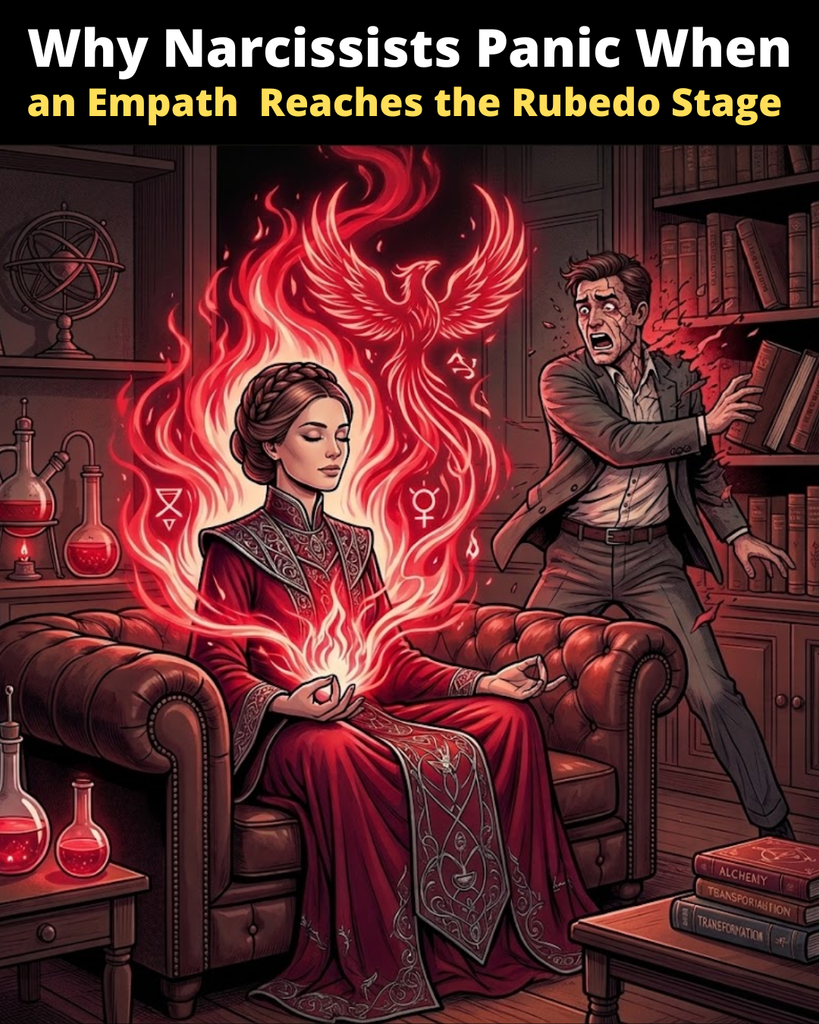
So What Does Rubedo Even Mean?
Well, it’s Latin, and it means something like “reddening.” It comes from alchemy, that old mix of early chemistry and magic where people spent their whole lives trying to turn ordinary metal into gold. They never managed it, obviously. But they believed the work went through stages, usually four of them, and each stage had a color. The black stage was called the nigredo, then came a white stage, the albedo, then a yellow one, the citrinitas, and at the very end, if everything went right, the red stage, the rubedo.
Where it gets interesting is Carl Jung, the Swiss psychiatrist. He was fascinated by all this and wrote whole books about alchemy, Psychology and Alchemy being the best known one. Jung thought these old stages were really a picture of how a person changes on the inside. He described the rubedo as a growing redness that brings “an increase of warmth and light,” according to this overview of his writing.
So when people online say an empath has “reached the rubedo stage,” there’s nothing magical going on. It’s just a poetic way to say she went through the worst years of her life and came out the other side in one piece. Maybe even in better shape than before.
Is it a little dramatic as a name? Sure. But I kind of like it, because anyone who lived through those years knows they really did feel black, and the end really can feel warm.
A Quick Word About Empaths And Narcissists
First of all, “empath” is not a word you’ll find in any medical book. The closest thing science has is what psychologist Elaine Aron calls the highly sensitive person. In a 2014 study from Stony Brook University, brain scans showed that highly sensitive people, about 20% of everybody, had more activity in the areas linked to empathy. In plain words, they really do pick up other people’s feelings more strongly. Which is lovely, until you’re married to someone who learns how to use that against you.
The same goes for “narcissist.” Narcissistic personality disorder is a real diagnosis, but only a professional can make it, and the Cleveland Clinic says it affects somewhere between 0.5% and 5% of people in the U.S. I’m using both words here the way we all use them at the kitchen table.
Is There Any Real Science Behind It?
For the alchemy, no. For the idea behind it, actually yes. Back in the 1990s two psychologists, Richard Tedeschi and Lawrence Calhoun, noticed that many people who survived something terrible didn’t just get back to normal. Some of them grew. They called it post-traumatic growth, and according to BrainLine, it usually shows up as new possibilities in life, feeling stronger, closer relationships with the right people, more appreciation for ordinary days, and sometimes a deeper spiritual life.
I find that list kind of comforting, to be honest. Although I should add that growth doesn’t mean the pain goes away, and not everybody feels it. Plenty of women grow a lot and still have bad days years later. If you don’t feel “transformed” yet, nothing is wrong with you.
How People Usually Get There
Nobody wakes up in the rubedo. If you talk to women who got there, almost all of them describe a long, messy road, and most of them didn’t know they were on any road at all until they looked back.
The Dark Years
This is the black stage, and for most people it’s the longest one. From the outside everything might look normal. You go to work, you make dinner, you smile at the neighbors. But at two in the morning you’re still replaying how a simple question about the electric bill turned into you apologizing for an hour. You start doubting your own memory. “I never said that.” “You’re too sensitive.” “You always make everything about you.” After enough years of that, you honestly can’t tell anymore who’s right. Maybe you cry in the car so the kids won’t see. A lot of that stays in the body long after the relationship ends, which I wrote about in 12 quiet signs of trauma from narcissistic abuse.
Then, for many women, there’s a moment. Sitting in the parked car outside the grocery store, reading something on the phone, and thinking, oh my God, that’s him, that’s exactly what he does. Suddenly there are words for it. Gaslighting. Silent treatment. Love bombing. It doesn’t fix anything yet. But knowing you weren’t crazy is a big deal.
The Slow Climb Out
After that comes the long, boring middle part, and I mean boring in a good way. You go back to the garden, or the choir, or the pottery class he said was a waste of money. You text an old friend you haven’t talked to in six years and she answers in five minutes like nothing happened. Saying no is awful at first. You explain it four times and apologize twice. Then it gets a little easier. And some days you go backwards, you answer his message when you promised yourself you wouldn’t, or you cry over a song in the supermarket. That’s part of it too.
One day your sister-in-law asks you to host Thanksgiving again, the way you have for fifteen years, and you hear yourself say, “Not this year, but I’ll bring the pies.” Nobody claps. Nobody even notices. But you notice.
And somewhere after that, usually years later, you bump into him at the pharmacy, say hello, pick up your blood pressure pills, and spend the drive home thinking about what to make for dinner. That’s pretty much what people mean by the rubedo.
Why He Can’t Handle Her Anymore
Fear is probably too big a word. A narcissist isn’t going to run away screaming. But a woman who got this far has quietly taken away almost every tool he used to have, and most of them really don’t know what to do about it. The biggest one is that she stopped reacting. Most narcissists need a reaction more than anything, praise if possible, but tears and slammed doors work too, because either way he’s still the main character. As I wrote in why narcissists provoke you on purpose, the reaction is often the whole point. So when the sarcastic comment gets a shrug, and the long angry text gets a one-line answer the next afternoon, there’s just nothing left to play with.
Another thing is that she sees it coming now. Before, it took her years. Now a new man tells her on the third date that she’s different from every woman he’s ever met, and instead of melting, she smiles and says, “That’s sweet, let’s see how it goes.” And she notices that he looks a little annoyed.
Funny enough, she’s still kind, and people are often surprised by that. Soup still shows up at the door when somebody’s sick, and nobody’s birthday gets forgotten. But she stopped handing her patience to people who only take, and for the man who picked her exactly because she never ran out of it, that’s a real problem.
She Has People Around Her Now
Other than that, she’s not alone anymore. Narcissists do best when their partner is cut off from everybody. By now she has her sister back, a couple of good friends, maybe a support group. So when he calls her best friend to say she’s “not herself lately,” the friend just says, “Funny, she seems great to me,” and tells her about the call over coffee the next morning.
They both laugh about it a little. Five years ago that same call would have worked, and she would have spent a week wondering if maybe he was right.
If You’re Still In The Dark Years
Maybe you’re reading this at two in the morning, and all of this sounds very far away. That’s okay. Most women who got there were exactly where you are now, convinced it would never end.
You don’t have to jump to the red stage. You only need the next small step. Tell one person you trust what’s really going on at home. Write down what happened today, with the date, so you can trust your memory later. Go for a walk without your phone. Small things, but they add up, much faster than it feels from the inside.
When He Tries To Come Back
And a lot of them do try. People call it hoovering, like the vacuum cleaner, because the whole idea is to suck you back in.
It usually comes out of nowhere, often right before a birthday or a holiday. “I’ve been thinking about you a lot.” “I finally get it now.” Sometimes there’s a crisis, he lost his job or he’s sick, and you’re the only one who ever understood him.
Someone still in the dark years would answer within a minute, heart pounding, hoping this time it’s real. A woman in the rubedo reads it, feels maybe a small sting, puts the phone down and decides later. Often she doesn’t answer at all. If she does, it’s something short like “I hope things get better for you. Take care.” No long letters, no going over the past again, and definitely no door left open just in case.
Honestly, that calm little message bothers a narcissist more than any angry one could.
Please Don’t Turn This Into Revenge
I want to say this clearly, because a lot of posts about empaths and narcissists slowly turn into revenge fantasies. The rubedo is the opposite. She isn’t trying to make him suffer or prove anything to anybody. She’s simply not available anymore, and she’s busy with her own life, her grandkids, her garden, her Tuesday walks with the neighbor. As I mentioned in a previous article about the 12 things narcissists hate, the things they hate the most are mostly just what happens when you start protecting yourself.
And if the person in your life has ever threatened you, pushed you or made you afraid, please don’t test any of this on him. Your safety is more important than any article. You can call the National Domestic Violence Hotline at 1-800-799-7233, or go to thehotline.org, and talk to someone confidentially.
Can He Change Too?
People ask me this a lot, and I don’t think anyone can honestly promise either way. Some people with strong narcissistic traits do get better with years of therapy, mostly when they really want to. Many never do, because they don’t think anything is wrong with them. That being said, the nice thing about the rubedo is that her peace doesn’t hang on his answer anymore. Whether he goes to therapy, marries someone new or stays exactly the same, her life goes on, and she’s the one deciding how.
How Do You Know You’re Getting There?
There’s no diploma at the end of this, and you don’t need to call yourself anything. But ask yourself a few things. Can you hear his name without your stomach dropping? When somebody tries to guilt-trip you, do you get curious instead of upset? Did you say no to something this month without a long speech? Have you caught yourself laughing and realized you hadn’t thought about him in days? If you grew up with a narcissistic mother or father, the road is often longer, because it started before you even had words for it. I wrote more about that in the truth about narcissistic parents. Just a tip. A therapist who understands emotional abuse can make the whole trip much shorter, and a lot less lonely.
The Bottom Line
Rubedo is an old alchemy word, not a diagnosis, but people use it now for something very real, getting through narcissistic abuse and growing from it. Psychologists have their own name for that, post-traumatic growth. A woman who gets there still feels everything deeply. She just doesn’t jump when he sighs anymore, she notices the charm on the third date, and she doesn’t need an apology to move on. For a narcissist that’s very hard to deal with, because there’s nothing left for him to hold on to.
Do you feel like you’ve reached this stage, or are you still on the way? Let us know in the comment box below.