
For years you and your husband talked about it over dinner. When we retire, we’ll sell the house and move somewhere warm. A small place by the sea, maybe, or back to the town where you grew up, close to your sister. No more shoveling snow, no more stairs.
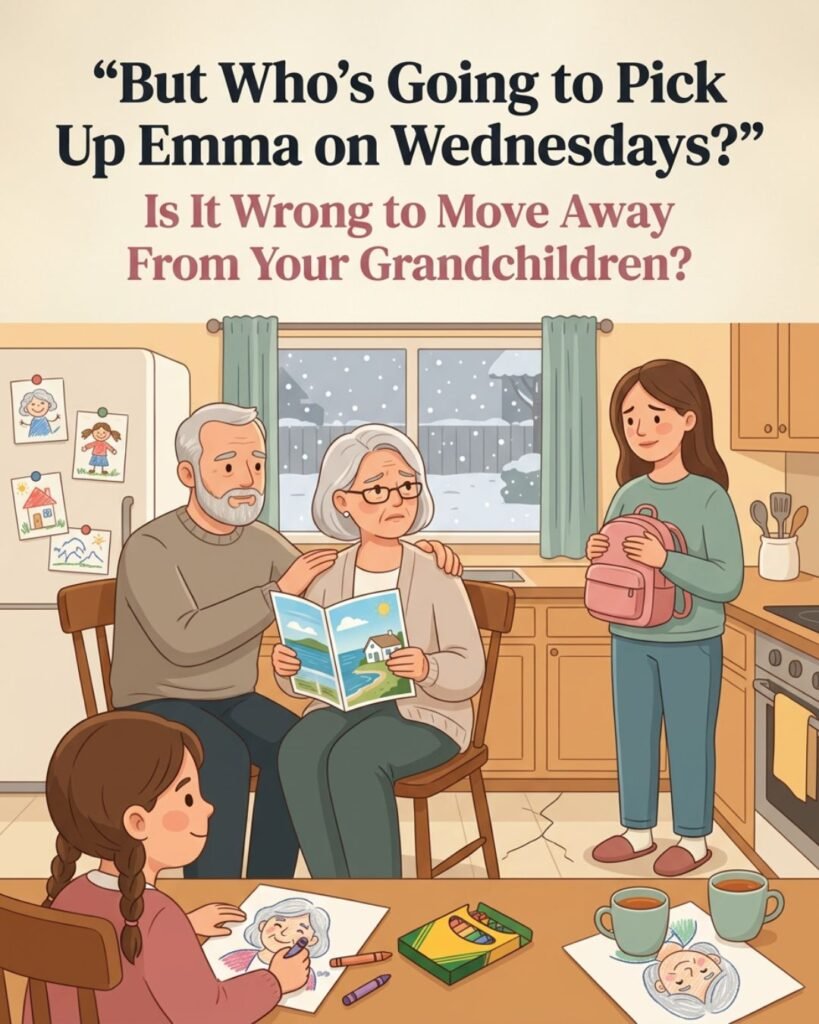
Then the day finally comes, and you tell your daughter. She’s quiet for a moment. Then she says, “But who’s going to pick up Emma on Wednesdays?”
And just like that, the dream you’ve been planning for twenty years starts to feel selfish.
If you’re in that spot right now, you’re not alone, and you’re not a bad grandmother for thinking about it. In this article we’ll look at whether it’s wrong to move away from your grandchildren in retirement, what research says about grandparents and grandkids, the questions worth asking before you decide and how to stay close from a distance. So, let’s go through it.
Long-Distance Grandparents Are Already Common
It might help to know how many families already live this way. In a large AARP survey of more than 2,600 grandparents, over half said they had at least one grandchild living more than 200 miles away. About a third lived more than 50 miles from even their closest grandchild.
And staying in touch has changed a lot. In AARP’s newer 2025 survey of more than 3,200 grandparents, 76% said technology like texting and video calls is one of their main ways of staying connected. Half of grandparents over 80 text their grandkids.
So a grandmother in Florida with grandchildren in Ohio is in very good company. There are millions like her.
Why So Many Retirees Want to Move
The reasons are usually practical, and they’re rarely about loving the grandchildren less.
Some people want a warmer climate, especially if arthritis makes winters harder every year, and the idea of spending another January scraping ice off the windshield at seven in the morning with stiff fingers has stopped sounding like a normal part of life and started sounding like a punishment. Others need to move somewhere cheaper because their pension simply doesn’t stretch far enough in an expensive city. Many want a single-floor home, or to be near good doctors as their health changes.
And some want to go home, to the village where they were born or to their siblings and old friends, sometimes in another country entirely. After decades of building a life around work and children, that pull can be very strong.
Health is often the quiet reason behind it all. A doctor suggests a gentler climate after a heart problem, or the old house with its steep staircase starts to feel risky after a fall. In those cases, moving can be one of the most responsible things you do for your family, because a grandmother who stays healthy and independent for longer is a gift to everyone, including the grandchildren who get to keep her around.
None of these are selfish reasons. They’re about the next twenty or thirty years of your own life, which matter too.
What Research Says About Grandparents and Grandkids
That said, the relationship really does matter, for both sides. Researchers at Boston College, Sara Moorman and Jeffrey Stokes, looked at decades of data on grandparents and their adult grandchildren. According to their findings, an emotionally close relationship was linked to fewer symptoms of depression in both generations.
They also found something interesting about help. Grandparents who both gave and received practical support had the fewest depressive symptoms over time, while those who only received help and couldn’t give any did worst. In other words, feeling useful matters a lot as we age.
A study from the Berlin Aging Study pointed in the same direction. According to KSL’s report on it, grandparents who occasionally helped with childcare had a 37% lower risk of dying over the study period than grandparents who didn’t. But there’s an important catch. Grandparents who were the main caregivers weren’t included, and the researchers warned that heavy caregiving can bring enough strain to cancel out the benefits.
So the research leaves plenty of room for living in another town. What it points to is closeness and moderate involvement, and it warns that being completely worn out helps nobody.
When You’ve Become the Family’s Free Daycare
Many grandparents are doing far more than occasional babysitting. AARP’s 2025 survey found that grandparents put in the equivalent of 12.5 full-time work weeks of grandchild care every year. That’s more than 500 hours.
Some grandparents love it, and many say it gives them energy. But others are quietly exhausted. They retired from one job and walked straight into another, without a salary or vacation days, and they feel they can’t say so without seeming ungrateful.
Picture a 68-year-old grandmother with a bad knee, chasing a two-year-old around the playground three afternoons a week. She adores him. She also hasn’t seen her own friends in months, and she’s started dreading Tuesday mornings, then feeling guilty for dreading them, then lying awake wondering what kind of grandmother feels that way.
If that sounds like you, it’s worth being honest with yourself before deciding anything about moving. Sometimes a different arrangement would solve more than a different city would. And keeping up with toddlers is one of those things that get harder with age, whether we like to admit it or not.
Questions Worth Asking Before You Decide
There’s no single right answer here. But a few questions can help you see your own situation more clearly.
How Old Are the Grandchildren?
Moving away when the grandkids are toddlers is very different from moving when they’re teenagers. Little children change fast, and long gaps between visits can feel like a lot. Teenagers, on the other hand, are busy with school and friends, and many of them actually text grandparents more easily than they talk on the phone.
Is Your Family Depending on You?
If your daughter is a single mom who relies on you for childcare so she can work, moving away is a much bigger decision than if you babysit once a month for fun. That doesn’t mean you can’t go. It means you need to talk early and help them find another plan before you leave.
That might mean staying a few extra months while they arrange daycare, or helping pay for the first term of after-school care. A gentle handover is a gift, and it can take a lot of the sting out of the goodbye.
What Happens When You’re 85?
This one is uncomfortable, but it’s important. The move that feels perfect at 65 might feel very lonely at 85, if you need rides to the doctor or help after a fall and your children are a long flight away. Some people solve this by planning a second move later on. Others choose a place with good community support from the start.
Can You Afford to Visit, Often?
Long-distance grandparenting works best when visits are regular. Before you buy the house by the sea, add up what three or four round trips a year will cost, and whether you’ll still be comfortable traveling in ten years.
What About Moving Closer Instead?
Some retirees go the opposite way and sell everything to move near their grandchildren. That can be wonderful. But it’s worth one honest question first: what happens if your son gets a job offer in another state in three years?
It happens more often than people expect. Picture a couple who leave their friends of forty years to buy a condo near their daughter, and two years later her husband is transferred across the country. Now they’re in a town where they know nobody, and the grandchildren are gone anyway.
If you’re thinking about moving closer, try renting first for a year. And build your own life there too, with friends and activities of your own, so you’re not depending on one family for all your company.
How It Might Feel From Your Child’s Side
It can help to imagine the conversation from the other chair. Your daughter is 38, working full time with two small kids, and you’ve been her safety net for years. When you say you’re moving, she may hear “you’re on your own now,” even if that’s not at all what you mean.
Underneath the practical worry, there’s often something more tender. She may be sad that her children won’t grow up with Grandma around the corner the way she imagined. She may even feel a little abandoned, which is hard to admit at 38.
None of that means you shouldn’t go. It just helps to answer the feeling as well as the logistics. “I know this is hard. I’m going to miss the kids terribly too” can open a much softer conversation than a list of flight schedules.
How to Tell Your Family
Try not to make it a surprise announcement. Talk to your children while you’re still thinking, not after you’ve signed the papers. Even if your mind is mostly made up, they’ll feel very differently about being included early.
Be honest about your reasons, and be specific about how you plan to stay close. “We’re moving, but we’ll come for two weeks every summer and every Christmas, and we’ll pay for the kids to visit us at Easter” lands much better than “We’ll visit when we can.”
Picture sitting down with your son and his wife at their kitchen table, with a map open on your phone. You show them the little town, the house with one floor and the spare room you’ve already decided will be “the kids’ room.” Suddenly the goodbye comes with an invitation, and everyone at the table can picture the first summer visit.
And let them be sad. Your daughter might be upset at first, partly about the childcare and partly because she’ll simply miss you. Both feelings make sense. Give it a little time before you decide she’ll never forgive you.
How to Stay Close From Far Away
Video calls really can help, even with very young children. In a study at Lafayette College, psychologist Lauren Myers and her team found that toddlers who had live video chats with an adult for a week learned from that person and recognized them later, while children who watched pre-recorded videos did not. The researchers found that from about 17 months, children start to get real value from live video calls with people they know.
So read a bedtime story over video once a week. Let the grandkids show you their drawings, or their new loose tooth. Keep it short with little ones, since five happy minutes beats twenty restless ones.
Old-fashioned mail still works wonders too. Children love getting a real envelope with their name on it, and a postcard from Grandma’s town can end up on the fridge for years.
Many long-distance grandparents also do a “grandma camp,” where the older grandkids come and stay for a week or two each summer without their parents. Those weeks often turn into the memories the children talk about most when they grow up, long after they’ve forgotten every birthday present, because what they remember is the smell of your kitchen and the night you all stayed up late watching the stars.
Sixty and Me has a helpful video with more ideas for staying close as a long-distance grandmother.
Be the One Who Listens
Distance changes the kind of grandparent you can be. You can’t pick them up from school. But you can be the person they tell things to.
Ask about the small stuff. Their best friend, or the video game they’re suddenly obsessed with. Remember it, and ask again next week.
Older kids, especially teenagers, sometimes find it easier to talk to a grandparent who isn’t there every day. You’re outside the daily arguments about homework and screen time. That makes you safe.
Holidays need a plan, too. If you’ve moved far away, decide early which ones you’ll spend together, and accept that your children may also want some holidays with their in-laws or on their own. More couples are doing that now anyway, as I wrote in why more couples skip Christmas with their parents.
One Honest Note
Sometimes people want to move away for reasons that are harder to say out loud. Maybe the relationship with a grown child has been difficult for years, or you feel more like a babysitter than a guest in their home. If that’s part of it, it’s worth being honest with yourself, and maybe talking it through with a counselor, so the move doesn’t become a way to avoid a conversation that still needs to happen.
It’s also okay to change your mind. Some people move away and come back after a few years. Others stay and move later. A decision at 65 doesn’t have to be the final word at 75.
And if you decide to stay close, try to make it something you chose freely. Respect your children’s rules with the grandkids, and remember there are some things grandparents should never do without asking, no matter how near you live.
So, Is It Wrong?
No. Moving away from your grandchildren in retirement can be a perfectly reasonable choice. Like most big decisions in life, it comes with trade-offs.
What matters is how you do it. Talk early, and keep showing up, even if it’s through a screen. Children notice whether Grandma remembers the name of their stuffed rabbit and calls on their birthday, and that sticks with them far longer than how many miles were in between.
Have you moved away from your grandchildren, or are you thinking about it? Let us know in the comment box below.