
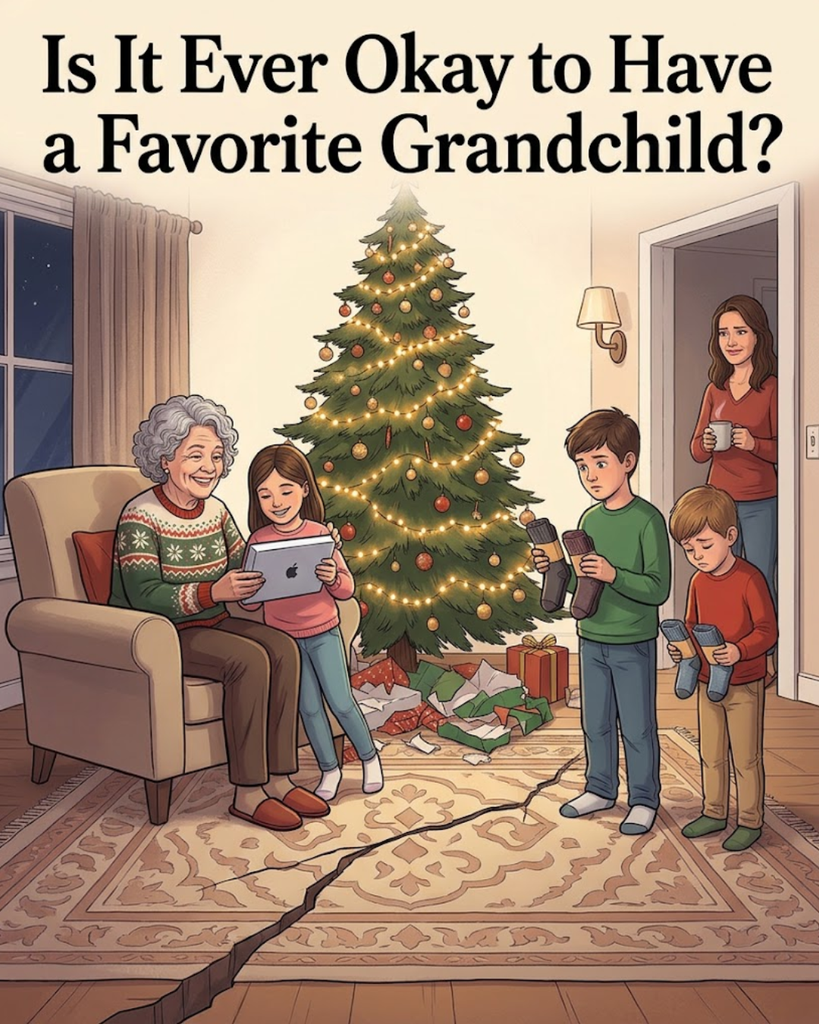
It’s Christmas morning at Grandma’s house. Your niece Olivia, who lives ten minutes away and sees Grandma every week, opens a big box with a brand-new tablet inside. Everyone claps.
Then your two boys open theirs. A pair of socks each, and a gift card.
Nobody says anything. Your sons say thank you, like you taught them. But on the drive home, your nine-year-old asks quietly from the back seat, “Why does Grandma like Olivia more than us?”
And you don’t know what to say, because you’ve been wondering the same thing for years.
If you’ve been on either side of that moment, as the parent or as the grandparent, this article is for you. We’ll look at how common it is for grandparents to favor one grandchild, why it happens, whether it’s ever okay and what both grandparents and parents can do about it. So, let’s go through it.
More Grandparents Have a Favorite Than Will Admit It
Most grandparents will tell you they love all their grandchildren the same. Privately, quite a few feel differently. In a YouGov survey of British adults over 50, about one in five grandparents with two or more grandchildren said they had a favorite. Grandmothers were a little more likely to say so than grandfathers, 21% compared with 16%.
Interestingly, only 11% of the same age group said they had a favorite among their own children. It seems people feel freer to have a favorite grandchild than a favorite child, maybe because it feels less serious. To the grandchildren, it doesn’t always feel that way.
When the grandparents explained their choice, the reasons were pretty ordinary. Being the first grandchild came up a lot, and so did good manners and simply spending plenty of time together.
Why It Happens
In most families, nobody decides to have a favorite. It just creeps in over the years.
Time and Distance
The grandchild who lives around the corner and comes over every Tuesday after school will naturally feel closer than the one who lives three states away and visits twice a year. You know her friends’ names and what she’s scared of. With the faraway grandchild, you’re starting over a little at every visit, asking the same polite questions about school while she answers in one word and looks at her mother, and by the time you’ve both warmed up, it’s time to drive back to the airport.
That’s normal. But it can quietly turn into bigger gifts and more photos on the fridge, along with more stories told about one child than the others.
The Daughter’s Children
This one surprises a lot of people. In a 2009 study published in Evolutionary Psychology, researchers asked college students about their relationships with all four grandparents. According to the study, contact and closeness were highest with the mother’s mother and lowest with the father’s father.
The researchers explained it through evolution and certainty about who’s really related to whom. There’s also a simpler, everyday explanation. Many young mothers lean on their own moms for help with the baby, so the maternal grandmother is simply around more from the very beginning.
Either way, it’s something many daughters-in-law notice, and it can sting. It’s one of those things mothers-in-law do that daughters-in-law never forget, often without meaning any harm.
The First Grandchild
The first grandchild often holds a special place. Everything is new. You were younger and had more energy, and you were there for the first steps and the first words.
By the time grandchild number five arrives, you might be 72 and recovering from a hip replacement. You may love the youngest every bit as much. You simply have less to give, and the youngest can feel it.
It helps to remember that each grandchild only gets one childhood. To little Max, it doesn’t matter that you were more energetic with his oldest cousin fifteen years ago. He only knows how you are with him now.
Personality and Shared Interests
Some grandchildren are just easier. The polite eight-year-old who likes baking cookies with Grandma is easier to spend an afternoon with than the loud, restless one who wants to play video games. That’s human.
But the restless one usually knows exactly which grandchild Grandma enjoys more, even if nobody says it out loud.
Kids Notice, Even Very Young Ones
Children are remarkably sharp about fairness. In a 2011 study led by Vanessa LoBue, children as young as three years old reacted negatively when stickers were shared unequally between them and another child. They were most upset when they got fewer.
Research on parents shows how much this can matter over time. A large 2025 review of studies on parental favoritism, reported by the American Psychological Association, found that children who were favored less tended to have poorer mental health and more strained family relationships. And an earlier study of older mothers and their grown children found that the perception of unequal treatment was linked to more depressive symptoms in middle age, for the favored children as well as the others.
Those studies are about parents, of course, and grandparents usually play a smaller role in a child’s life. But the basic feeling, “I’m not as loved as my cousin,” is the same, and children tend to carry it longer than adults expect.
So yes, they notice. Usually more than we’d like.
Being the Favorite Isn’t Always Easy Either
It’s tempting to think the favored grandchild has it made. Often they don’t.
Many grown-ups who were Grandma’s favorite remember feeling uncomfortable about it, standing in the living room holding the biggest present while a younger cousin stared at the floor, and wishing, just a little, that Grandma had wrapped something smaller. They could see their cousins being left out, and sometimes the cousins blamed them for it. Family gatherings got awkward, and nobody really knew why.
The favorite can also feel a lot of pressure to stay perfect, to keep the good grades and the polite manners that earned the special treatment in the first place. And as the 2010 study on mothers found, unequal treatment seemed to weigh on every child, including the ones who came out ahead.
So treating your grandchildren fairly is a gift to the favorite as well. It lets them simply be a kid.
So, Is It Ever Okay?
Feeling closer to one grandchild is normal and, honestly, very common. Feelings aren’t something we can always control. What matters is what you do with them.
Fair and identical are also two different things. Sometimes one grandchild genuinely needs more. A grandchild with a serious illness, or one whose parents are going through a divorce, might need more of your time for a while. Giving it is love responding to need, and most families understand that.
The key is to be open about it. “Jake needs a little extra help this year, and I’ll make sure we have our special day too, Emma” goes a long way. Children can accept a lot when they understand the reason and still feel seen, and a sick cousin getting extra visits from Grandma rarely causes resentment when everyone has been told what’s going on and nobody is quietly left out of the plans.
Where It Crosses the Line
It stops being okay when the difference becomes visible and keeps happening without any explanation.
Big differences in gifts are the most obvious example. A tablet for one and socks for another is something children will remember for decades, and many adults can still tell you exactly what their cousin got for Christmas in 1987, down to the color of the wrapping paper. The same goes for comparisons said out loud, like “Why can’t you be as tidy as your cousin?”
Money is another big one. A grandparent who quietly pays for one grandchild’s college and nothing for the others can split a family in two after the funeral. If you’re thinking about how to divide things fairly, I wrote about whether parents should leave more to the child who cared for them, and many of the same questions apply to grandchildren.
Step-Grandchildren and Late Arrivals
Blended families make this harder. A grandmother who has known her biological grandchildren since birth may feel very differently about the two step-grandchildren who arrived when her son remarried. That’s understandable.
But imagine being the ten-year-old stepgrandson who watches his new cousins get stockings with their names stitched on them, while he gets one from the drugstore. Nobody meant to be unkind. He’ll still remember it.
If you’re in this situation, the fix is surprisingly simple. Treat every child at the table the same on the big occasions, and let the closeness with each one grow at its own pace.
For Grandparents: How to Keep It Fair
Start by being honest with yourself. If you already know who your favorite is, that awareness is half the work.
Set a gift budget per grandchild and stick to it, even when you see something perfect for one of them. If you can’t help yourself, save it for their birthday rather than Christmas, when everyone is comparing.
If one grandchild asks why a cousin got something bigger, answer honestly and kindly. “You’re right, that wasn’t fair of me. Let’s pick something out together next week.” Children respect a grandparent who can admit a mistake far more than one who pretends nothing happened.
Make one-on-one time with each child, especially the ones you find harder, because the grandchild who seems difficult in a noisy crowd of cousins is often a completely different person when it’s just the two of you on a park bench with an ice cream. A day at the zoo with the restless boy might surprise you. Kids are often very different when their cousins aren’t around.
Learn something specific about each grandchild. The faraway granddaughter’s best friend, or the shy grandson’s favorite dinosaur. Ask about it next time. It shows them you were paying attention.
And check the fridge. If all the photos are of one family, a few new pictures can quietly fix something you never meant to do.
A Few Sentences That Help
For grandparents, it helps to have some words ready.
To a grandchild who feels left out: “I love you to the moon. Let’s plan something, just you and me.”
To your own child, when they raise it: “Thank you for telling me. I didn’t see it that way, but I can see why it hurt.”
And to yourself, quietly: “Is this something I’d be comfortable with if all the grandchildren were watching?” Because usually, they are.
For Parents Who See It Happening
If you’re watching your child get less love or attention from a grandparent, it hurts in a very particular way. It reminds many of us of our own childhoods.
Talk to the grandparent privately, calmly and with a specific example. “Mom, the boys noticed the difference in gifts this year, and Sam asked me if you love Olivia more. I know that’s not what you meant.” Most grandparents are horrified to hear it and want to fix it right away, because the last thing they ever intended was to make a child feel less loved, and many simply had no idea how their small habits looked from the outside.
Talk to your kids too, without criticizing Grandma in front of them. Something like, “Grandma sees Olivia more often because she lives close by. This has nothing to do with you, and you didn’t do anything wrong.” That last part matters most.
And if the grandparent keeps ignoring your concerns, you’re allowed to limit the situations that hurt your kids. You’re the parent. Grandparents have important roles, but there are still some things grandparents should never do without asking, and making your children feel second best should be on that list.
When It’s the Other Grandmother
Sometimes the comparison isn’t between cousins at all. It’s between the two sets of grandparents. One grandma sends a check every birthday and visits monthly, while the other forgets birthdays entirely, and the kids notice that too.
There isn’t much you can do about the other side of the family. But you can avoid making it worse. Try not to say, “Well, Grandma Linda never remembers anything,” in front of the children, even when you’re frustrated. Kids often feel they have to defend a grandparent you criticize, and it puts them in the middle of something that was never theirs to carry, especially when they’re still young enough to believe that every adult in the family loves them equally.
One Honest Note
In some families, favoritism toward one grandchild is part of a much older pattern. If your own mother always had a “golden child” and now treats your sister’s kids as the stars while yours get criticized, it may be the same dynamic, simply passed down one generation. If that sounds familiar, there’s more in the truth about narcissistic parents.
But most of the time, it’s simpler and much more human than that. A grandmother sees one child more, connects with one more easily and doesn’t realize how it looks from the outside. Usually, a gentle, honest conversation is all it takes.
If you’re a grandmother reading this and recognizing yourself, please don’t panic. It’s one of the easiest family problems to fix. Call the grandchild you’ve been seeing less. Ask about their week. Then call again the week after, and the week after that.
Small, steady attention adds up faster than you’d think.
Years from now, what your grandchildren carry with them is whether they felt they mattered as much as everyone else at the table. The price tags fade much faster.
Have you ever felt that a grandparent favored one grandchild in your family? Let us know in the comment box below.
Focus keyphrase: favor one grandchild
SEO title: Grandparents Who Favor One Grandchild: Is It Ever Okay?
Meta description: Why some grandparents favor one grandchild, what research says about how kids notice, when treating them differently is fair, and how to fix it.
Slug: grandparents-favor-one-grandchild