
It usually hits in the grocery store. You’re walking down the aisle in early November, and there it is, the canned cranberry sauce with the ridges on it. Mom always bought that one. Everybody made fun of it every single year, and everybody ate it anyway.
You stand there holding the can a little too long. A woman with a full cart has to go around you.
Then the group chat starts. Your brother asks, “So what are we doing this year?” Nobody answers for two days, because nobody knows. Mom always did Thanksgiving. She did the turkey, the stuffing with the sausage, the pie she started the night before. She was the reason everybody came home.
If this is your first Thanksgiving without your mom, I’m so sorry. I want to say right away that there’s no right way to do this. In this article I want to go through why the first one hurts so much, what families usually do to get through it, a few ways to keep her at the table, and what to watch for if the grief doesn’t get lighter with time. So, let’s go through it.
Why The First One Is So Hard
Grief doesn’t follow a calendar, but holidays have a way of finding every soft spot. Thanksgiving especially, because for a lot of families it was built around one person in one kitchen. When she’s gone, it’s not just the turkey that’s missing. It’s the noise she made, the way she bossed everybody around, the phone call two days before to ask if you were bringing the green bean casserole.
I think it also hurts because everything around you is so cheerful. The commercials, the store decorations, the neighbors putting up lights. A hospice group, VITAS Healthcare, points out that being around happy people can make grief feel even stronger. They also say something I found really true. The days before the holiday are often harder than the day itself.
So if you’re dreading it right now, that dread is part of it. Many people say the actual Thursday was easier than they expected, maybe because by then the waiting is over, everybody is finally in the same room, and there’s food to carve and dishes to wash and small kids to keep away from the stove, so there’s just less time to sit and think.
Talk About It Before The Day
The worst thing families can do is pretend nothing changed and just wait to see what happens. Usually what happens is that everybody shows up with a different idea in their head, and somebody ends up crying in the bathroom.
Well, it doesn’t have to be a big formal meeting. A phone call, a video chat, or a coffee with your siblings is enough. Ask simple questions. Where do we want to be? Who wants to cook, and who would rather not? Is there anything Mom always did that we really want to keep, and anything we’d honestly be relieved to drop?
If Dad Is Still Here
This part is hard, because your father, or your mom’s partner, just lost the person he spent maybe fifty years with. He might want everything exactly the same. Or he might not be able to stand being in that kitchen at all. Ask him, gently, and listen to the answer, even if it’s not what you expected. Some fathers surprise everybody and want to cook the turkey themselves for the first time in their lives.
And please don’t leave him alone that day, even if he says he’s fine. Plenty of men say they’re fine. Then they sit in the recliner all afternoon with the TV on mute, and you only find out later that he hasn’t eaten a real meal since Monday. Maybe someone can stay the night, or at least call him before bed.
When Siblings Want Different Things
Your sister wants everything just like Mom did it, down to the same tablecloth. Your brother wants to go to a restaurant so nobody has to be in that house. Both are grieving, they just do it differently. Very often the oldest daughter quietly ends up taking over everything, which I wrote about in why the eldest daughter ends up managing the family. If that’s you, it’s okay to ask for help. You don’t have to become your mother this year.
Try to find the thing you all agree on, even if it’s small. Maybe the meal is at your house but you go to the cemetery together in the morning. Maybe you go to the restaurant but take her pie recipe and make it together on Friday. A compromise that nobody loves is still better than a fight that everybody remembers.
If You’re Cooking It For The First Time
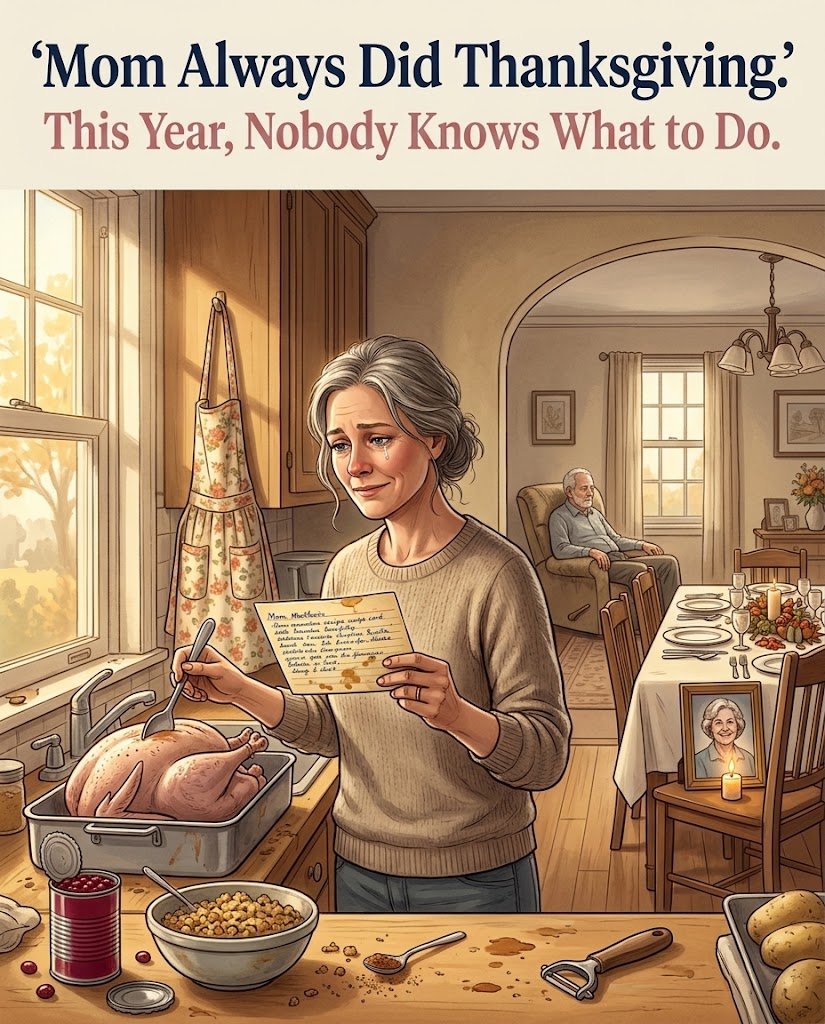
A lot of women find themselves in Mom’s role this year without ever really deciding it. Suddenly you’re the one with the 22-pound turkey in your fridge and her recipe card on the counter, and you realize she never wrote down half of it. “A little bit of sage.” How much is a little bit, Mom?
Here’s what I’d say. Make it easier on yourself. Turn it into a potluck, let your brother bring the mashed potatoes, buy the rolls. If the stuffing doesn’t taste exactly like hers, that’s okay, it was never going to, because part of what made it taste like that was her standing at the stove complaining that nobody ever helps in this kitchen while everybody stood around eating it straight out of the pan before dinner.
And if you burn something, well, she probably did too, at least once. Ask your aunt.
Keep Some Traditions, Change Others
There’s no rule that says you have to keep everything. Some families keep the meal exactly the same, because it feels like Mom is still there. Others change almost everything this first year, a different house, a different time, even pizza instead of turkey, because the old way just hurts too much.
Most families end up somewhere in the middle. Maybe your aunt makes the sausage stuffing from Mom’s handwritten recipe card, the one with the gravy stains on it. Maybe you skip the pie because nobody can make it like she did, and buy one from the bakery instead. Nobody will mind. Honestly, nobody will even notice.
Just a tip. Decide about the chair before the day. Some families leave Mom’s seat empty on purpose, others find that unbearable and move the chairs around so there’s no gap. Neither is wrong, but it’s much easier to decide over coffee in October than standing at the table with the turkey getting cold.
Small Ways To Keep Her At The Table
A lot of families find that doing one small thing for Mom makes the whole day feel lighter, not heavier. It gives the sadness somewhere to go.
Some light a candle next to her photo at the start of the meal. Others go around the table and everybody shares one memory, the funny ones usually work best. Like the year she forgot the turkey in the garage, or the time she told the new son-in-law he was “too skinny” in front of everybody. You’ll probably laugh and cry at the same time. That’s okay.
You could also cook her signature dish together, with the grandkids helping, so the recipe gets passed on. Or put out a small box and some paper, and let everybody write a note to her during the day to read later. Or play her favorite old record while you clean up, if that’s what she always did.
It doesn’t need to be big. It just needs to be hers.
Have A Plan For The Morning
For many people the hardest part of the whole day is the morning, before anybody arrives. The house is quiet, the parade is on TV, and that’s exactly when you’d normally call her to ask how long the turkey needs.
So it can really help to plan something for those first hours. Some families go to the cemetery together, bring flowers, maybe her favorite coffee. Others go for a walk, or call a sibling who lives far away just to say “I’m thinking about her too.” One woman might keep busy peeling potatoes from seven o’clock on purpose, another might stay in bed an extra hour and cry, and both of them are doing it right.
Whatever you choose, don’t let the morning just ambush you.
It’s Okay To Laugh, And It’s Okay To Leave The Table
Something strange happens at a lot of first holidays. One minute everybody is laughing about Mom’s terrible jokes, and the next minute someone has to step outside. People sometimes call these grief bursts, sudden waves of sadness that come out of nowhere, set off by a smell or a song or the sight of her serving spoon.
Let them happen. If you need ten minutes in the backyard, take them. And if you catch yourself having a nice time, please don’t feel guilty about it. Laughing at Thanksgiving doesn’t mean you miss her less. She would probably be glad you’re laughing.
Resilience researcher Lucy Hone lost her 12-year-old daughter in a car crash, and she gave a TED talk about what helped her keep going. One of her ideas is to choose, on purpose, where you put your attention, and to look for the good things that are still there, even on the worst days. It’s about sixteen minutes, and I think it’s one of the kindest talks about grief out there.
When People Say The Wrong Thing
At some point during the day, somebody will probably say something that stings. “She’s in a better place now.” “At least she lived a long life.” “Are you still sad about it?” Most of the time people mean well, they just don’t know what to say, so they grab whatever sentence comes to mind first.
You don’t have to correct them, and you don’t have to pretend it helped either. A simple “Thank you, we really miss her” is enough, and then you can go refill your drink.
And if you’re the friend or the cousin reading this, the kindest thing you can do is actually very simple. Say her name. Tell a story about her. Most grieving people aren’t afraid of talking about their mom. They’re afraid everybody else has already forgotten her.
The Grandkids Are Grieving Too
Children often grieve in bursts too. A seven-year-old might seem perfectly fine, playing with the cousins, and then suddenly ask at the table where Grandma’s chair went. Answer honestly and simply. “Grandma died, and we miss her. It’s okay to talk about her.”
Teenagers sometimes go quiet or act like they don’t care. Usually they do. Giving them a small job, like setting up her photo or making her cookies, can help them feel part of it without having to say much.
And if a grandchild asks the same question three times during dinner, answer it three times. That’s how kids work through big things, and the patience you show them that day is something they’ll remember long after they forget what was on the table.
What If You Just Can’t Face It This Year?
That’s allowed too. Some families skip the big dinner the first year and go to a restaurant, rent a cabin for a few days, or volunteer at a soup kitchen together. Others stay home in their pajamas and watch football. None of that means you’re forgetting her. As I wrote in 9 things that get harder with age and what helps, being around people matters a lot when life gets hard, so if you skip the big gathering, try to have at least one person with you.
You can always go back to the old traditions next year, or the year after. Or you can build new ones. Many families find that by the third or fourth Thanksgiving, they’ve created something that feels like theirs, with Mom still part of it in small ways.
When Grief Doesn’t Get Lighter
Grief is not an illness. It’s the price of loving someone, and for most people it slowly gets softer, even if it never fully goes away. But for some people it stays just as heavy, or gets heavier. According to the American Psychiatric Association, an estimated 4% to 15% of bereaved adults have what’s called prolonged grief disorder. For adults, it’s only considered after at least 12 months, and it includes things like intense longing almost every day, feeling like part of you died too, and having a hard time going back to normal life.
If that sounds like you, or your dad, or one of your siblings, please talk to a doctor or a grief counselor. Many hospices offer free grief support groups for families, even if your mom wasn’t in their care. There’s nothing weak about asking for help, especially in the first year.
The Bottom Line
The first Thanksgiving after Mom died is going to be hard, and there’s no way to make it not hard. But it helps a lot to talk about it with your family before the day, decide together what to keep and what to change, and find one small way to keep her at the table. Let yourself laugh, let yourself cry, and leave the room when you need to. And if you can’t face the whole thing this year, that’s okay too. She’d probably just want everybody to eat and be together.
What helped your family get through the first holiday without your mom? Let us know in the comment box below.