
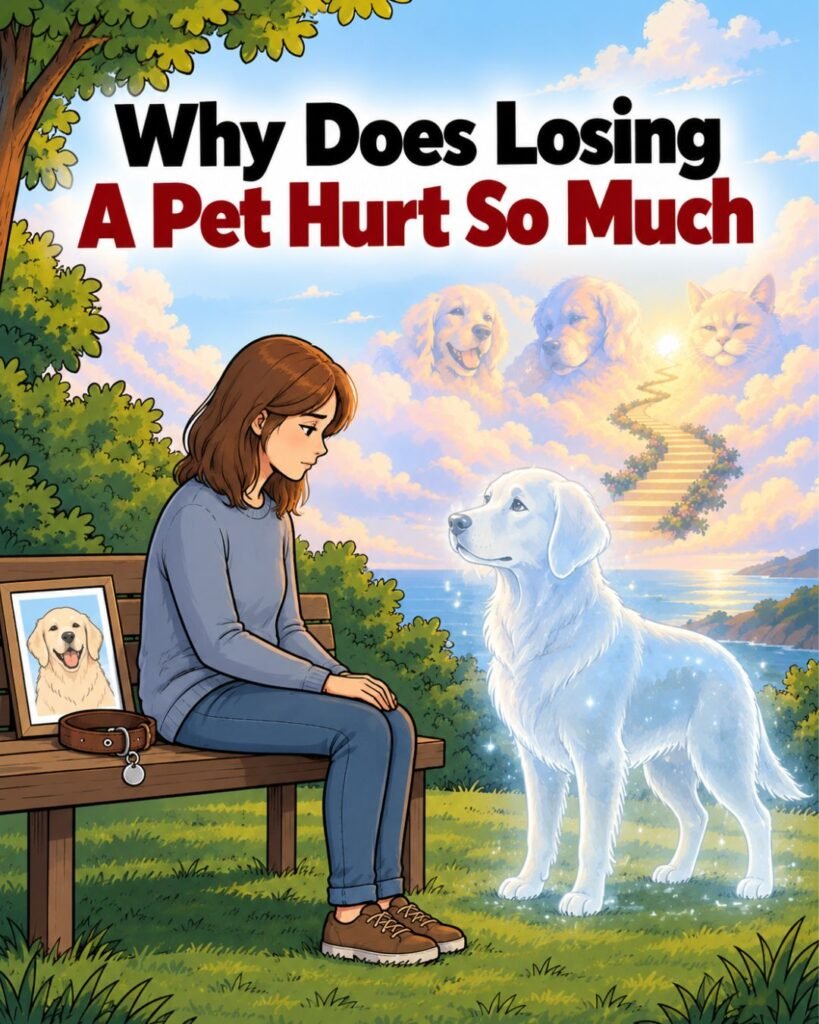
There is a particular kind of silence in a house after a pet dies. You notice it in the small things. Nobody is waiting by the door. Nobody moves when you open the fridge. The food bowl is still standing in the corner, and you cannot bring yourself to pick it up.
And then somebody says it. “It was just a dog.” Or “You can always get another one.”
Those words land badly, and most people who say them do not mean any harm at all. They simply have no idea what they are talking about.
So why does it hurt this much? Why can the death of an animal that weighed six kilograms knock a grown adult flat in a way that surprises even them?
This is a question I see over and over in the comments on this site, usually written by someone who feels a little ashamed of how hard they are taking it. Today I want to answer it properly. Not with a list of comforting phrases, but with what the research actually says, and with the reasons this particular loss hits so deep.
If you are in the middle of it right now, I hope this helps you feel less strange and less alone.
It Is Not “Just A Dog”, And The Research Agrees
Let’s start with the thing everybody gets wrong.
There is a common assumption that grief for an animal is a smaller version of grief for a person. A sort of grief-lite. Researchers have actually tested this, and the results are more interesting than you might expect.
When studies compare people grieving a pet with people grieving a human being, the human loss does come out somewhat heavier on average. But once researchers account for how close the person felt to whoever died, that closeness explains almost everything, and the species stops mattering very much at all.
Read that again, because it matters. What predicts the size of the grief is the size of the bond. Not what kind of animal was on the other end of it.
And for a great many people, the bond with the animal was not the smaller relationship. In a large Pew Research Center survey of American adults, 97 percent of pet owners said their pet was part of the family, and about half said their pet was as much family as any human member. Those are not people confusing a dog with a child. Those are people describing where their actual affection lives.
So if you are grieving harder than you expected, you are not broken, and you have not lost your sense of proportion. You are grieving in proportion to a bond that other people never saw from the inside (more on the research here).
Disenfranchised Grief: The Name For What You Are Feeling
There is a term for this, and learning it helped me understand the whole problem much better.
In 1989, a grief researcher named Kenneth Doka gave a name to grief that society does not openly acknowledge, approve of, or make room for. He called it disenfranchised grief. It is the grief nobody sends a card about.
Pet loss sits right in the middle of this category. You do not get bereavement leave for it in most jobs. There is no funeral where people gather and say kind things. Nobody brings food to your house. Your colleagues expect you at your desk the next morning with your normal face on.
And here is the cruel part. The lack of recognition does not just fail to help you. It actively makes the grief worse.
A qualitative study published in 2025 interviewed 31 people who had lost animals, and one of the strongest themes to come out of it was the psychological toll of exactly this: the emotional burden compounded by isolation. When you cannot mourn openly, the feelings have nowhere to go. They just circle.
So you start editing yourself. You cry in the car instead of the kitchen. You tell people you are tired rather than sad. And after a few weeks you begin to wonder whether something is wrong with you for still being wrecked.
Nothing is wrong with you. You are carrying a real loss without permission to carry it, and that is a much heavier job.
Why This Bond Is Different From Almost Every Other One
Think about your relationships with the humans in your life. Even the very good ones are complicated. There is history. There are old arguments and things left unsaid, moods to read, apologies that never quite arrived.
Now think about your relationship with your animal.
There was no history to manage. No disappointment. Your dog never brought up something you said in 2019. Your cat never withdrew affection to make a point. The animal did not care what you did for a living, how the year had gone, or whether you had brushed your hair.
Freud noticed this a long time ago and described it as affection without ambivalence. That is a good phrase for it. It is one of the very few relationships in a human life that is genuinely uncomplicated.
Which means when it ends, the mourning is uncomplicated too – and that is exactly why it comes in so cleanly and so hard. There is no anger mixed in to dilute it. No unfinished business to be angry about. Just the pure loss of something that was, in a way, almost nothing else was, simply good.
Also, this bond does not run on words. Nobody ever explained anything to anybody. It was built entirely from presence, touch, and daily habit, which is a much older and deeper part of the human brain than language is.
Your Whole Day Was Built Around Them
This is the part people underestimate, and in my opinion, it is one of the biggest reasons the pain lasts.
When a person you love dies, your daily routine usually survives. You still wake at the same time. You still do the same things.
When an animal dies, the routine dies with them.
You woke up at a certain hour because something was standing on your chest. You went outside twice a day whether you felt like it or not. Your evening had a shape because at nine o’clock somebody wanted their dinner. You came home to a greeting. You slept with a weight against your legs.
All of that vanishes at once, and it vanishes about forty times a day. Every one of those small moments is a fresh little reminder. This is why grieving a pet often feels less like one big wave and more like being tapped on the shoulder constantly for weeks.
For anyone living alone, this hits even harder. For older people, or anyone going through a stretch where the animal really was the main daily company, the loss is not only the animal. It is the reason to get up, the structure of the day, and the only source of affectionate physical contact, all removed on the same afternoon.
Nobody warns you about that part.
The Guilt Nobody Prepares You For
And then there is the thing that separates pet loss from almost every other kind of grief. Very often, the decision was yours.
Human beings are not usually asked to choose the hour of a loved one’s death. Pet owners are asked exactly that, in a small room, while somebody waits for an answer.
It does not matter that it was the kind thing to do. It does not matter that everyone agreed. The mind goes back to it anyway, and it brings questions. Was it too early? Did I wait too long and let them suffer for the extra week because I could not face it? Should I have noticed sooner? Was the lump there in the spring?
That last one is very common. Animals hide pain because hiding pain is what keeps an animal alive in the wild. So they cover it up until they cannot anymore, and afterwards you replay every ordinary day of the last few months looking for the sign you missed.
There is another version of this guilt too. Some people feel relief when a long illness finally ends, and then feel monstrous for feeling it. Relief after a long stretch of caretaking is normal, and it is not a betrayal of anything.
I will not tell you to simply stop feeling guilty, because that never works. But it helps to know that this specific guilt is close to universal, that it is a feature of the situation rather than evidence of a failure, and that it usually softens with time.
Grief Can Genuinely Affect Your Body
People say a broken heart like it is only a figure of speech. It is not entirely.
There is a real, recognized heart condition called takotsubo syndrome, better known as broken heart syndrome. Under severe emotional stress, the main pumping chamber of the heart changes shape and temporarily weakens. The symptoms look a lot like a heart attack: sudden chest pain, pressure on the chest, shortness of breath.
It is not a heart attack, and the condition is usually temporary, with most people recovering fully. But the British Heart Foundation notes it is more common in women and in people over 50, and grief is one of the classic triggers.
It is rare, and I am not telling you this to frighten anybody. I am telling you because a lot of readers on this site are exactly in that group, and because it makes an important point: intense grief is a physical event, not only an emotional one.
Milder physical effects are far more common and completely normal. Broken sleep. No appetite, or too much appetite. Constant tiredness. A heavy or tight feeling in the chest. Getting sick more easily than usual.
One thing to be clear about, though. If you ever get sudden severe chest pain or trouble breathing, do not sit at home deciding whether it is grief. Get medical help immediately. Let a doctor be the one to tell you it was only your heart aching.
What Actually Helps
There is no trick that makes this quick. Anyone selling you one is not being straight with you. But some things genuinely help, and some things genuinely do not.
Things Worth Trying
Give the loss a name and let yourself say it out loud. “My dog died, and I am devastated.” Not “I lost my pet, silly, I know.” The apology in that second sentence is the disenfranchisement doing its work on you from the inside.
Find the people with what one writer nicely called dogmanity. You know who they are. They are the friends who will let you talk about it for an hour without once checking their phone. Spend your energy on them and stop trying to explain yourself to the ones who do not understand. You will not convince them, and the effort costs you something you cannot spare right now.
Make some kind of ritual. It sounds small, and it is not. A photo printed and framed. A plant in the garden. The collar kept in a box in the drawer. Writing down the things you do not want to forget, like the specific stupid way they slept. Ritual gives grief a shape, and shapeless grief is much harder to carry.
Be specific about what you miss. Research on grief suggests this genuinely helps. Instead of a vague ache, name it: the sound of the nails on the floor, the greeting at the door, the weight on your feet at night. Naming the pieces makes the loss something you can hold rather than something formless sitting on your chest.
Wait on the question of another animal. Not never, and not because it would be disloyal. Just not while you are still deciding whether to move the food bowl. Get a new animal when you want that animal, not when you want the old one back.
When To Reach Out For More Support
Grief does not follow a timetable, and there is no correct number of weeks. It comes in waves, it circles back, and a Tuesday in November can knock you down for no obvious reason.
That said, it is worth talking to your doctor or a counsellor if several months have passed and it is not easing at all, if you cannot function at work or at home, if you are withdrawing from everyone, or if the guilt has settled in and will not move.
Pet loss support groups exist, both in person and online, and many veterinary practices can point you to one. Some countries have dedicated pet bereavement helplines. There is no prize for doing this alone, and asking for help with this kind of loss is not an overreaction.
If you are struggling in a way that frightens you, please talk to someone today rather than waiting to see whether it passes.
Where There Is Grief, There Was Love
If you take one thing away from this article, take this.
The pain is the size of the love. That is the whole equation. It is not a malfunction, it is not sentimentality, and it is not something to be embarrassed about in front of people who never got to see what you had.
You gave an animal a whole good life. You fed them, you noticed when something was wrong, you sat with them at the end, and made the hardest decision on their behalf so that they did not have to be afraid. That is not a small thing. That is about the best thing a person can do for another living creature.
So do not let anybody tell you it was just a dog. It was not, and you both knew it. If you have lost an animal you loved, tell me about them in the comments below. Their name and one thing they used to do that made you laugh. I read every comment, and this is one place where nobody will tell you that you are overreacting.