
It’s late, and you’re scrolling through Facebook in bed when a post catches your eye: “10 Signs You’re Dealing With a Narcissist.” You read it once. Then you read it again, more slowly.
Your mother-in-law, who has criticized your cooking for 26 years, ticks four boxes. Your sister, who turns every phone call into a story about herself, ticks five. The boss at work ticks three, and if you’re being honest, the woman who runs the church bake sale ticks at least two. By the end of the list, you’re wondering whether you’re surrounded by narcissists, or whether you’re the problem.
You’re probably neither. Some people in your life are simply hard to be around. A much smaller number have a deeper pattern that wears you down in a different way. Telling them apart matters, because what works with one can backfire badly with the other. In this article we’ll look at what narcissists and difficult people have in common, the patterns that set them apart, and how to protect yourself from each. So, let’s go through it.
Why Everyone Seems to Be a Narcissist Lately
Not long ago, we rarely used the word. Now it’s everywhere, from TikTok to the checkout line. It gets attached to anyone who forgets our birthday or talks too long at dinner.
Part of the reason is that the word finally gave a name to something many of us struggled to explain for years. Plenty of women in their 50s and 60s first heard it on a podcast or in a Facebook group and suddenly understood their own childhood. The trouble starts when it becomes a label for anyone who annoys us.
Doctors do recognize a genuine diagnosis here, called narcissistic personality disorder (NPD for short), but far fewer people have it than social media suggests. According to the Cleveland Clinic, experts estimate that between 0.5% and 5% of people in the U.S. may have it. The official checklist has nine items. Among them are an inflated view of one’s own importance, a hunger to be admired, the feeling of being owed special treatment and little feeling for other people’s pain. Someone has to meet five or more before a professional will give the diagnosis.
Narcissistic traits are another matter. They sit on a spectrum, so plenty of people have a few without having the disorder.
One honest note before we go on. Only a qualified professional can diagnose NPD, after talking with the person. None of us can do it from across the dinner table. What we can do is notice patterns of behavior. Then we can decide how to protect ourselves, whatever the official label might be.
Psychologist Dr. Ramani Durvasula, a leading expert on narcissism, has also warned that tossing the word around too casually can backfire. When everyone is a narcissist, people who’ve lived through real narcissistic abuse have a harder time being believed.
What They Have in Common
On a bad day, a narcissist and a difficult person can look almost identical. Both can be rude and critical. Either one can make a family gathering feel like a minefield.
Bill Eddy is a lawyer and therapist who co-founded the High Conflict Institute. He has spent years studying people who create conflict wherever they go. He calls them high-conflict people, and as Big Think explains, they tend to share four traits. They’re preoccupied with blaming others, they think in all-or-nothing terms, they struggle to manage their emotions, and they react in extreme ways to small things, like yelling at a waitress or storming out of a birthday dinner because the restaurant gave away their table and nobody seemed sorry enough about it.
Eddy points out that some studies suggest up to 15% of people have a personality disorder of some kind. But not all of them are high-conflict, and plenty of high-conflict people don’t have a personality disorder at all. The overlap is real, but it isn’t complete.
He explains his approach in this short video. It’s worth five minutes of your time if someone in your life fits that description.
The Patterns That Tell Them Apart
So how do you tell the difference? No single moment will tell you. What tells you is the pattern over months and years, and a few questions can help you see it.
Can They Say Sorry and Mean It?
This is one of the clearest signs. A difficult person may be stubborn, but once they calm down, they can usually admit they were wrong. It might take a day. It might come out clumsily, with a plate of cookies instead of the actual words. But it comes.
With narcissism, apologies are rare, or they come with a twist like “I’m sorry you feel that way.” Researchers in the UK looked at this across four studies published in 2017. People who scored higher in narcissism were less willing to apologize when they’d hurt someone. The reason came down to empathy and guilt. They felt less of both, so they saw little reason to say sorry.
Think about the last real argument you had with the person you’re wondering about. Did they ever come back to it on their own, without being pushed, and acknowledge their part?
Is It a Bad Season or a Lifelong Pattern?
Everyone’s personality shifts a little from day to day. A 2016 diary study tracked 178 university students over 10 days. It found that even ordinary people became a bit more self-focused on days when things went well for them. We all get a little full of ourselves after a win.
Life events can make kind people difficult for a while, too. A friend who’s caring for a parent with dementia, going through a divorce or living with chronic pain may snap at you in ways she never used to, and then call you the next morning, embarrassed, to ask whether you’re still friends. When she’s prickly for a season, that tells you about her circumstances. When someone has treated people this way for 30 years, through good times and bad, that tells you about their character.
If you grew up with a parent who was hard in a way that never changed, you might find it helpful to read about the long shadow of narcissistic parents.
Who Gets the Worst of It?
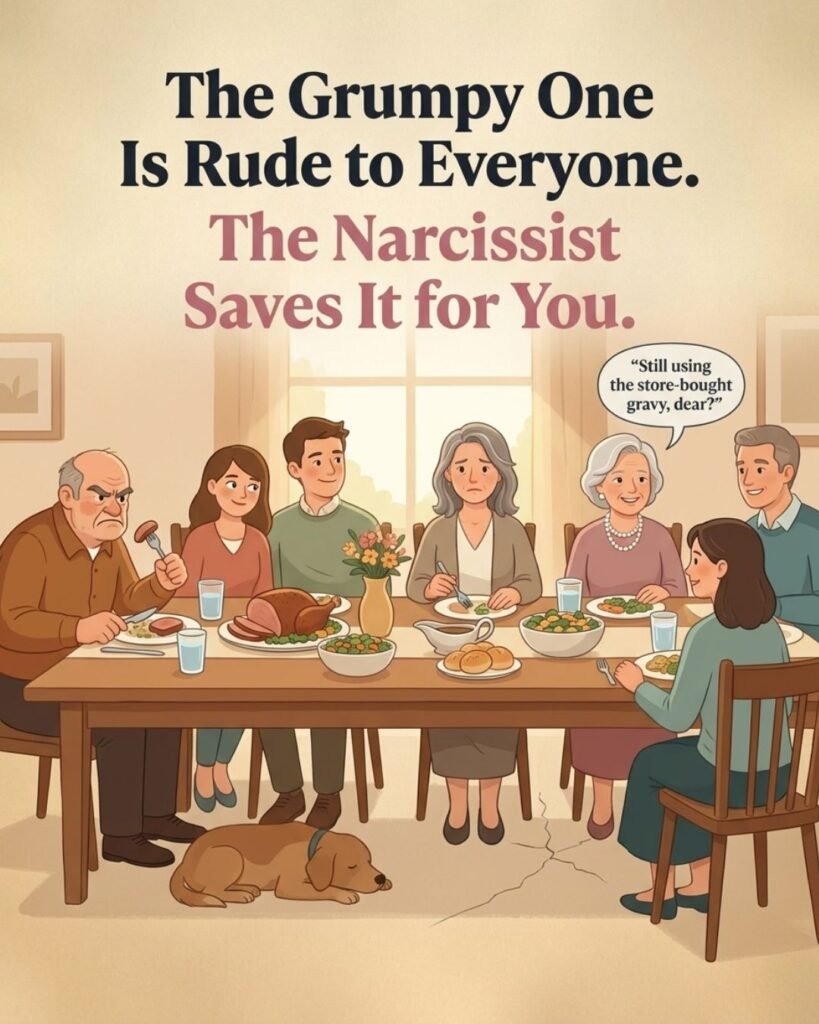
Difficult people are usually difficult with everyone. Your grumpy neighbor is short with you, with the mailman, with the young man who delivers his groceries and probably with his own reflection in the mirror. It’s unpleasant, but it’s fairly democratic.
Narcissistic people are often charming in public, and their worst behavior is saved for those closest to them. Friends and church members may describe your husband as the nicest man they know. Meanwhile, you’re the one who sees the cold silences at home. Eddy describes something similar with high-conflict people. They often pick one target of blame, usually an intimate partner or someone in authority, and focus their anger on that person.
That gap between the public face and the private one is one of the most confusing parts. It can make you doubt your own experience, because nobody else seems to see it.
Does Your Pain Register With Them?
A difficult person might be blunt or set in their ways. But when you’re truly hurting, they usually notice, even if they show it awkwardly. In a study from the Universities of Surrey and Southampton, people high in narcissistic traits showed less empathy for someone in distress. Their heart rates barely changed while they watched her suffer.
There’s an interesting twist, though. When the researchers asked those same people to imagine how the woman felt, their empathy went up. Their heart rates looked like everyone else’s, too. So the capacity was there. They just didn’t use it unless someone told them to, which probably sounds familiar if you’ve ever had to explain to someone why their comment hurt you, again and again, for years, while they looked back at you as if you were speaking a foreign language.
What Happens When You Say No?
Boundaries work like a kind of test, even when you don’t mean them to. Tell a difficult person you can’t host Thanksgiving this year, and you’ll probably hear some grumbling. Maybe a sigh on the phone. A week later, they’ve moved on and are asking what they should bring to your sister’s house instead.
Say the same thing to someone with a strong narcissistic pattern, and the reaction is often out of all proportion. There might be days of silence and guilt trips, or a call to your brother about how ungrateful you’ve become. The “no” itself becomes the crime, and the original question about Thanksgiving gets lost somewhere along the way, buried under accusations about who you really are and how much you’ve changed since you married that man.
So pay attention to what happens after you set a small limit. The reaction tells you a lot.
How Do You Feel After You’ve Been With Them?
This might be the most useful question of all. Dr. Ramani suggests a simple exercise. Write two columns on a piece of paper, one for people you find annoying and one for people you suspect are narcissistic, and then notice how you feel after spending time with each.
Annoying people leave you irritated. You might vent to a friend on the phone, roll your eyes and move on with your day.
With narcissistic people, the feeling is usually heavier. You come home and replay the conversation for hours. Guilt creeps in, though you can’t say what you did wrong. You start questioning your own memory. Over time, that kind of relationship can leave lasting marks. If you recognize them, our article on the signs of trauma from narcissistic abuse may help you put words to them.
Dr. Ramani explains the difference in this video.
Do They Get Better With Age?
Sometimes, a little. Researchers followed 486 students from the University of California, Berkeley, starting at age 18, and checked back on 237 of them 23 years later. Most had become less narcissistic by 41. Only about 3% had become more narcissistic. Vanity dropped the most in people who settled into serious relationships or had children.
That’s encouraging, but it’s an average across a group of young people growing into middle age. It doesn’t promise that your 72-year-old mother will suddenly soften. People in positions of power, like supervisors and bosses, declined less, because their roles kept feeding the pattern, and in some older people, illness and a loss of control can make difficult traits sharper.
If you’re watching that happen with someone in your family, we wrote about whether age makes a narcissist more dangerous.
How to Handle Each One
With a difficult person, honest conversation often works. Pick a calm moment, keep it about one specific thing and say how it affected you. “When you corrected me in front of the kids, I felt embarrassed.” A difficult person may grumble, but there’s a decent chance they’ll hear you, and the relationship can actually improve, sometimes more than you’d expect after years of tiptoeing around each other at holidays and birthday parties.
With someone who shows a clear narcissistic pattern, that same honest talk can turn into a three-hour argument about everything you’ve done wrong since 1987, and somehow you’ll end the evening apologizing to them for bringing it up in the first place. Here a different approach usually works better.
Eddy recommends what he calls a BIFF response for emails, texts and tense moments. It stands for Brief, Informative, Friendly and Firm. You keep it short, stick to facts, add a polite word and close the topic. “Thanks for letting me know. We’ll arrive at two and leave at five. See you Sunday.” No long explanations, and no hoping they’ll finally understand.
Eddy also advises keeping your suspicions to yourself. Telling someone “you’re a narcissist” almost never helps, and with a high-conflict person, it usually pours fuel on the fire, because now they have a brand-new reason to feel attacked and a brand-new story to tell everyone about how cruel you’ve been. Treat it as a private working theory that guides how you respond.
And try not to take the bait when they push your buttons on purpose. If that’s a pattern you know too well, you might want to read about why narcissists provoke you.
What If You’re Worried It’s You?
Plenty of women who read lists like these end up turning the questions on themselves. Was I too harsh with my daughter? Do I talk about myself too much?
Everyone has some self-centered moments, as that diary study showed. Being able to ask the question honestly, and to feel uncomfortable about the answer, is a good sign in itself, because it shows the kind of guilt and self-reflection that people with strong narcissistic traits tend to lack. If you notice a pattern in yourself that you don’t like, a few sessions with a therapist can help. It’s never too late to change how you show up for the people you love.
When It’s More Than Difficult
Some situations go beyond hard personalities. If someone controls your money, keeps you away from friends and family, threatens you or hurts you physically, that’s abuse, whatever label they might or might not have.
In the US, you can call the National Domestic Violence Hotline at 1-800-799-7233 or text START to 88788. It’s free and confidential, and it’s there for anyone, including women who’ve been married for decades. A therapist who understands narcissistic and high-conflict relationships can also help. Together you can sort out what you’re dealing with and what you want to do about it.
If you’re the one who’s been worn down and you feel guilty every time you’re happy, that’s a common pattern too. We wrote about why daughters of narcissistic mothers feel guilty for being happy and where that feeling comes from.
Final Thoughts
Not everyone who makes your life harder is a narcissist. Some people are tired, grieving, unwell or just plain grumpy, and they can still say sorry, notice when you’re hurting and change a little over time. Others have a pattern that doesn’t shift, no matter how kind or patient you are, and with them, the goal is to protect your peace rather than win the argument, because that argument was never really winnable in the first place. That’s a hard thing to accept.
You don’t need a diagnosis to trust what you’ve seen with your own eyes over the years. You just need to pay attention to the pattern and to how you feel when you walk away.